
MULTIFUNCTIONAL CARBON QUANTUM DOTS DERIVED FROM GREEN BEAN SEEDS FOR COPPER (ІІ) ION SENSING, NANOTHERMOMETRY, AND ANTIBACTERIAL APPLICATIONS

Article Sidebar
-
Green Synthesis, Carbon Quantum Dots (CQDs), Green Beans, Sensor, Antibacterial Activity
Abstract
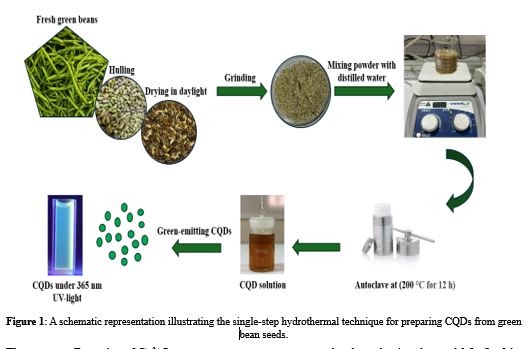
The increasing global demand for inexpensive and environmentally friendly fluorescent nanomaterials highlights the urgency of employing green synthesis approaches using biomass-based materials. Following the principles of green chemistry, the present study details a one-step hydrothermal synthesis of carbon quantum dots using green bean seeds as a carbon precursor, with no chemical additions. Photoluminescence (PL) spectroscopy showed excitation-dependent fluorescence properties with a peak green emission at 532 nm when excited at 490 nm and a quantum yield of 37.1%. Transmission electron microscopy (TEM) revealed uniform quasi-spherical nanoparticles (~5 nm). X-ray diffraction (XRD) confirmed a graphitic core. Fourier transform infrared spectroscopy (FTIR) and energy-dispersive X-ray spectroscopy (EDX) analyses revealed surface carbonyl and hydroxyl groups, with carbon and oxygen as principal elements. The CQDs demonstrated nanosensing capability for Cu²⁺ ions, with a limit of detection of 0.1 µM via fluorescence quenching. Temperature-dependent PL studies exhibited linearity in the 20 to 65°C range with a relative thermal sensitivity of 1.17% °C-1, confirming the nanothermometer capability of CQDs. Using the serial dilution method, CQDs represent antibacterial activity against Escherichia coli and Klebsiella bacteria. Multifunctional green bean-based CQDs have excellent potential for nanoscale temperature, heavy metal sensing, and biomedical applications.
Full text article
References
Arul, V., & Sethuraman, M. G. (2019). Hydrothermally green synthesized nitrogen-doped carbon dots from Phyllanthus emblica and their catalytic ability in the detoxification of textile effluents. ACS omega, 4(2), 3449-3457. https://doi.org/10.1021/acsomega.8b03674
Atchudan, R., Edison, T. N. J. I., Perumal, S., Vinodh, R., Sundramoorthy, A. K., Babu, R. S., & Lee, Y. R. (2022). Morus nigra-derived hydrophilic carbon dots for the highly selective and sensitive detection of ferric ion in aqueous media and human colon cancer cell imaging. Colloids and Surfaces A: Physicochemical and Engineering Aspects, 635, 128073. https://doi.org/10.1016/j.colsurfa.2021.128073
Atchudan, R., Edison, T. N. J. I., Shanmugam, M., Perumal, S., Somanathan, T., & Lee, Y. R. (2021). Sustainable synthesis of carbon quantum dots from banana peel waste using hydrothermal process for in vivo bioimaging. Physica E: Low-dimensional Systems and Nanostructures, 126, 114417. https://doi.org/10.1016/j.physe.2020.114417
Aydin, S., Yilmaz, A., & Yilmaz, M. (2024). Green Synthesis of Various Heteroatom‐doped Carbon Quantum Dots from Urine, Whey, and Their Mixture: The Optimization of Synthesis and Potential Applications. ChemistrySelect, 9(17), e202304930. https://doi.org/10.1002/slct.202304930
Bakier, Y., Ghali, M., & Zahra, W. (2020). Highly sensitive fluorescent detection of pyridine using small size carbon quantum dots derived from folic acid. Journal of Physics D: Applied Physics, 53(40), 405103. https://doi.org/10.1088/1361-6463/ab985e
Bandi, R., Gangapuram, B. R., Dadigala, R., Eslavath, R., Singh, S. S., & Guttena, V. (2016). Facile and green synthesis of fluorescent carbon dots from onion waste and their potential applications as sensor and multicolour imaging agents. Rsc Advances, 6(34), 28633-28639. https://doi.org/10.1039/C6RA01669C
Bucka, K., Socha, R. P., & Wojnicki, M. (2024). Carbon Quantum Dots as Phosphors in LEDs: Perspectives and Limitations—A Critical Review of the Literature. Electronics, 13(22), 4481. https://doi.org/10.3390/electronics13224481
Chahal, S., Macairan, J.-R., Yousefi, N., Tufenkji, N., & Naccache, R. (2021). Green synthesis of carbon dots and their applications. Rsc Advances, 11(41), 25354-25363. https://doi.org/10.1039/D1RA04718C
D’Souza, L. F., Jadhav, R. W., Bhosale, S. V., & Bugde, S. T. (2024). Crafting carbon quantum dots from acetone: dual purpose Fe3+ ion and pH sensing platform. Emergent Materials, 1-12. https://doi.org/10.1007/s42247-024-00792-0
Das, P., Maruthapandi, M., Saravanan, A., Natan, M., Jacobi, G., Banin, E., & Gedanken, A. (2020). Carbon dots for heavy-metal sensing, pH-sensitive cargo delivery, and antibacterial applications. ACS Applied Nano Materials, 3(12), 11777-11790. https://doi.org/10.1021/acsanm.0c02305
Das, S., Mondal, S., & Ghosh, D. (2024). Carbon quantum dots in bioimaging and biomedicines. Frontiers in bioengineering and biotechnology, 11, 1333752. https://doi.org/10.3389/fbioe.2023.1333752
Deme, G., Belay, A., Andoshe, D. M., Barsisa, G., Tsegaye, D., Tiruneh, S., & Seboka, C. (2023). Effect of hydrothermal reaction temperature on fluorescent properties of carbon quantum dots synthesized from lemon juice for adsorption applications. Journal of Nanomaterials, 2023(1), 1701496. https://doi.org/10.1155/2023/1701496
Elkun, S., Ghali, M., Sharshar, T., & Mosaad, M. M. (2024). Green synthesis of fluorescent N-doped carbon quantum dots from castor seeds and their applications in cell imaging and pH sensing. Scientific Reports, 14(1), 27927. https://doi.org/10.1038/s41598-024-78745-0
Feng, Y., Zhong, D., Miao, H., & Yang, X. (2015). Carbon dots derived from rose flowers for tetracycline sensing. Talanta, 140, 128-133. https://doi.org/10.1016/j.talanta.2015.03.038
Fu, H., Ji, Z., Chen, X., Cheng, A., Liu, S., Gong, P., Li, G., Chen, G., Sun, Z., & Zhao, X. (2017). A versatile ratiometric nanosensing approach for sensitive and accurate detection of Hg 2+ and biological thiols based on new fluorescent carbon quantum dots. Analytical and bioanalytical chemistry, 409, 2373-2382. https://doi.org/10.1007/s00216-017-0183-3
Gagic, M., Kociova, S., Smerkova, K., Michalkova, H., Setka, M., Svec, P., Pribyl, J., Masilko, J., Balkova, R., & Heger, Z. (2020). One-pot synthesis of natural amine-modified biocompatible carbon quantum dots with antibacterial activity. Journal of Colloid and Interface Science, 580, 30-48. https://doi.org/10.1016/j.jcis.2020.06.125
Gan, Z., Xu, H., & Hao, Y. (2016). Mechanism for excitation-dependent photoluminescence from graphene quantum dots and other graphene oxide derivates: consensus, debates and challenges. Nanoscale, 8(15), 7794-7807. https://doi.org/10.1039/C6NR00605A
Gedda, G., Lee, C.-Y., Lin, Y.-C., & Wu, H.-f. (2016). Green synthesis of carbon dots from prawn shells for highly selective and sensitive detection of copper ions. Sensors and Actuators B: Chemical, 224, 396-403. https://doi.org/10.1016/j.snb.2015.09.065
Guo, Z., Luo, J., Zhu, Z., Sun, Z., Zhang, X., Wu, Z.-c., Mo, F., & Guan, A. (2020). A facile synthesis of high-efficient N, S co-doped carbon dots for temperature sensing application. Dyes and Pigments, 173, 107952. https://doi.org/10.1016/j.dyepig.2019.107952
He, S., Turnbull, M. J., Nie, Y., Sun, X., & Ding, Z. (2018). Band structures of blue luminescent nitrogen-doped graphene quantum dots by synchrotron-based XPS. Surface Science, 676, 51-55. https://doi.org/10.1016/j.susc.2018.01.013
Hu, M., Guo, D., Tang, J., Liu, K., Lian, H., Xu, C., Xu, L., & Zhang, W. (2022). Temperature sensing performance of fluorescent carbon quantum dots prepared from loblolly pine processing waste. Russian Journal of Physical Chemistry A, 96(14), 3070-3081. https://doi.org/10.1134/S0036024423030202
Hu, S., Trinchi, A., Atkin, P., & Cole, I. (2015). Tunable photoluminescence across the entire visible spectrum from carbon dots excited by white light. Angewandte Chemie International Edition, 54(10), 2970-2974. https://doi.org/10.1002/anie.201411004
Jia, J., Lin, B., Gao, Y., Jiao, Y., Li, L., Dong, C., & Shuang, S. (2019). Highly luminescent N-doped carbon dots from black soya beans for free radical scavenging, Fe3+ sensing and cellular imaging. Spectrochimica Acta Part A: Molecular and Biomolecular Spectroscopy, 211, 363-372. https://doi.org/10.1016/j.saa.2018.12.034
Jumardin, J., Maddu, A., Santoso, K., & Isnaeni, I. (2021). Synthesis of carbon dots (CDS) and determination of optical gap energy with Tauc plot method. Jambura Physics Journal, 3(2), 73-86. https://doi.org/10.34312/jpj.v3i2.11235
Kalytchuk, S., Poláková, K. i., Wang, Y., Froning, J. P., Cepe, K., Rogach, A. L., & Zbořil, R. (2017). Carbon dot nanothermometry: intracellular photoluminescence lifetime thermal sensing. ACS nano, 11(2), 1432-1442. https://doi.org/10.1021/acsnano.6b06670
Kaur, N., Sharma, V., Tiwari, P., Saini, A. K., & Mobin, S. M. (2019). “Vigna radiata” based green C-dots: photo-triggered theranostics, fluorescent sensor for extracellular and intracellular iron (III) and multicolor live cell imaging probe. Sensors and Actuators B: Chemical, 291, 275-286. https://doi.org/10.1016/j.snb.2019.04.039
Khan, Z. M., Rahman, R. S., Islam, S., & Zulfequar, M. (2019). Hydrothermal treatment of red lentils for the synthesis of fluorescent carbon quantum dots and its application for sensing Fe3+. Optical Materials, 91, 386-395. https://doi.org/10.1016/j.optmat.2019.03.054
Kong, J., Wei, Y., Zhou, F., Shi, L., Zhao, S., Wan, M., & Zhang, X. (2024). Carbon quantum dots: properties, preparation, and applications. Molecules, 29(9), 2002. https://doi.org/10.3390/molecules29092002
Kroupa, D. M., Vörös, M., Brawand, N. P., McNichols, B. W., Miller, E. M., Gu, J., Nozik, A. J., Sellinger, A., Galli, G., & Beard, M. C. (2017). Tuning colloidal quantum dot band edge positions through solution-phase surface chemistry modification. Nature Communications, 8(1), 15257. https://doi.org/10.1038/ncomms15257
Kumar, S., Goswami, M., Singh, N., Sathish, N., Reddy, M., & Kumar, S. (2022). Exploring carbon quantum dots as an aqueous electrolyte for energy storage devices. Journal of Energy Storage, 55, 105522. https://doi.org/10.1016/j.est.2022.105522
Li, T., Li, Z., Huang, T., & Tian, L. (2021). Carbon quantum dot-based sensors for food safety. Sensors and Actuators A: Physical, 331, 113003. https://doi.org/10.1016/j.sna.2021.113003
Liu, S., Tian, J., Wang, L., Zhang, Y., Qin, X., Luo, Y., Asiri, A. M., Al‐Youbi, A. O., & Sun, X. (2012). Hydrothermal treatment of grass: a low‐cost, green route to nitrogen‐doped, carbon‐rich, photoluminescent polymer nanodots as an effective fluorescent sensing platform for label‐free detection of Cu (II) ions. Advanced materials, 24(15), 2037. https://doi.org/10.1002/adma.201200164
Liu, Y., Zhao, Y., & Zhang, Y. (2014). One-step green synthesized fluorescent carbon nanodots from bamboo leaves for copper (II) ion detection. Sensors and Actuators B: Chemical, 196, 647-652.
Luo, Y., Cui, C., Zhang, X., Jiang, Y., Xiang, Z., Ji, C., & Peng, Z. (2023). Carbon dots-based fluorescence assay for the facile and reliable detection of Ag+ in natural water and serum samples. Molecules, 28(4), 1566. https://doi.org/10.3390/molecules28041566
Magesh, V., Sundramoorthy, A. K., & Ganapathy, D. (2022). Recent advances on synthesis and potential applications of carbon quantum dots. Frontiers in materials, 9, 906838. https://doi.org/10.3389/fmats.2022.906838
Marouzi, S., Darroudi, M., Hekmat, A., Sadri, K., & Oskuee, R. K. (2021). One-pot hydrothermal synthesis of carbon quantum dots from Salvia hispanica L. seeds and investigation of their biodistribution, and cytotoxicity effects. Journal of Environmental Chemical Engineering, 9(4), 105461. https://doi.org/10.1016/j.jece.2021.105461
Mehta, V. N., Jha, S., Basu, H., Singhal, R. K., & Kailasa, S. K. (2015). One-step hydrothermal approach to fabricate carbon dots from apple juice for imaging of mycobacterium and fungal cells. Sensors and Actuators B: Chemical, 213, 434-443. https://doi.org/10.1016/j.snb.2015.02.104
Meiling, T. T., Cywiński, P. J., & Bald, I. (2016). White carbon: Fluorescent carbon nanoparticles with tunable quantum yield in a reproducible green synthesis. Scientific Reports, 6(1), 28557. https://doi.org/10.1038/srep28557
Mohammadnejad, M., & Ghiasi, M. (2025). Green synthesis of a fluorescence optical probe for Fe3+ based on Barberry derived carbon quantum dots: Deep insight on interaction from experimental and theoretical approach. Spectrochimica Acta Part A: Molecular and Biomolecular Spectroscopy, 125775. https://doi.org/10.1016/j.saa.2025.125775
Mohammed, L. J., & Omer, K. M. (2020). Dual functional highly luminescence B, N Co-doped carbon nanodots as nanothermometer and Fe3+/Fe2+ sensor. Scientific Reports, 10(1), 3028. https://doi.org/10.1038/s41598-020-59958-5
Molaei, M. J. (2023). Carbon quantum dots-based fluorescent layered double hydroxide for targeted drug delivery application. Diamond and Related Materials, 137, 110135. https://doi.org/10.1016/j.diamond.2023.110135
Mousa, M. A., Abdelrahman, H. H., Fahmy, M. A., Ebrahim, D. G., & Moustafa, A. H. (2023). Pure and doped carbon quantum dots as fluorescent probes for the detection of phenol compounds and antibiotics in aquariums. Scientific Reports, 13(1), 12863. https://doi.org/10.1038/s41598-023-39490-y
Nazibudin, N. A., Zainuddin, M. F., & Abdullah, C. A. C. (2023). Hydrothermal synthesis of carbon quantum dots: An updated review. J. Adv. Res. Fluid Mech. Therm. Sci, 101, 192-206. https://doi.org/10.37934/arfmts.101.1.192206
Pandiyan, S., Arumugam, L., Srirengan, S. P., Pitchan, R., Sevugan, P., Kannan, K., Pitchan, G., Hegde, T. A., & Gandhirajan, V. (2020). Biocompatible carbon quantum dots derived from sugarcane industrial wastes for effective nonlinear optical behavior and antimicrobial activity applications. ACS omega, 5(47), 30363-30372. https://doi.org/10.1021/acsomega.0c03290
Saber, Y. A., Hamed, M., Emara, S., Mansour, F. R., Locatelli, M., & Ibrahim, N. (2024). Garlic peel-based carbon quantum dots as a sustainable alternative for the sensitive and green spectrofluorometric quantification of molnupiravir in pharmaceutical capsules. Heliyon, 10(23). https://doi.org/10.1016/j.heliyon.2024.e40661
Sailaja Prasannakumaran Nair, S., Kottam, N., & SG, P. K. (2020). Green synthesized luminescent carbon nanodots for the sensing application of Fe3+ ions. Journal of Fluorescence, 30(2), 357-363. https://doi.org/10.1007/s10895-020-02505-2
Salman, B. I. (2023). A novel design eco-friendly microwave-assisted Cu–N@ CQDs sensor for the quantification of eravacycline via spectrofluorimetric method; application to greenness assessments, dosage form and biological samples. Journal of Fluorescence, 33(5), 1887-1896. https://doi.org/10.1007/s10895-023-03190-7
Saravanan, A., Maruthapandi, M., Das, P., Luong, J. H., & Gedanken, A. (2021). Green synthesis of multifunctional carbon dots with antibacterial activities. Nanomaterials, 11(2), 369. https://doi.org/10.3390/nano11020369
Scaria, J., Karim, A. V., Divyapriya, G., Nidheesh, P., & Kumar, M. S. (2020). Carbon-supported semiconductor nanoparticles as effective photocatalysts for water and wastewater treatment. In Nano-Materials as Photocatalysts for Degradation of Environmental Pollutants (pp. 245-278). Elsevier. https://doi.org/10.1016/B978-0-12-818598-8.00013-4
Sciortino, A., Cannizzo, A., & Messina, F. (2018). Carbon nanodots: a review—from the current understanding of the fundamental photophysics to the full control of the optical response. C, 4(4), 67. https://doi.org/10.3390/c4040067
Sharma, N., Das, G. S., & Yun, K. (2020). Green synthesis of multipurpose carbon quantum dots from red cabbage and estimation of their antioxidant potential and bio-labeling activity. Applied Microbiology and Biotechnology, 104, 7187-7200. https://doi.org/10.1007/s00253-020-10726-5
Singh, M., Manickavasagan, A., Shobana, S., & Mohan, V. (2021). Glycemic index of pulses and pulse-based products: a review. Critical Reviews in Food Science and Nutrition, 61(9), 1567-1588. https://doi.org/10.1080/10408398.2020.1762162
Sudolska, M., Dubecky, M., Sarkar, S., Reckmeier, C. J., Zboril, R., Rogach, A. L., & Otyepka, M. (2015). Nature of absorption bands in oxygen-functionalized graphitic carbon dots. The Journal of Physical Chemistry C, 119(23), 13369-13373. https://doi.org/10.1021/acs.jpcc.5b04080
Sun, J., Yan, K., Zhang, P., Pan, A., Chen, X., & Shi, X. (2024). Green-emitting carbon quantum dots: highly sensitive temperature sensing probe in nanocomposite and lubrication system. Lubricants, 12(3), 88. https://doi.org/10.3390/lubricants12030088
Tadesse, A., RamaDevi, D., Hagos, M., Battu, G., & Basavaiah, K. (2018). Facile green synthesis of fluorescent carbon quantum dots from citrus lemon juice for live cell imaging. Asian J. Nanosci. Mater, 1(1), 36-46. https://doi.org/10.26655/ajnanomat.2018.1.5
Tan, X. W., Romainor, A. N. B., Chin, S. F., & Ng, S. M. (2014). Carbon dots production via pyrolysis of sago waste as potential probe for metal ions sensing. Journal of analytical and applied pyrolysis, 105, 157-165. https://doi.org/10.1016/j.jaap.2013.11.001
Verma, S. K., Das, A. K., Gantait, S., Panwar, Y., Kumar, V., & Brestic, M. (2022). Green synthesis of carbon-based nanomaterials and their applications in various sectors: a topical review. Carbon Letters, 32(2), 365-393. https://doi.org/10.1007/s42823-021-00294-7
Xie, Y., Zheng, J., Wang, Y., Wang, J., Yang, Y., Liu, X., & Chen, Y. (2019). One-step hydrothermal synthesis of fluorescence carbon quantum dots with high product yield and quantum yield. Nanotechnology, 30(8), 085406. https://doi.org/10.1088/1361-6528/aaf3fb
Xu, Q., Gao, J., Wang, S., Wang, Y., Liu, D., & Wang, J. (2021). Quantum dots in cell imaging and their safety issues. Journal of Materials Chemistry B, 9(29), 5765-5779. https://doi.org/10.1039/D1TB00729G
Yadav, P. K., Chandra, S., Kumar, V., Kumar, D., & Hasan, S. H. (2023). Carbon quantum dots: synthesis, structure, properties, and catalytic applications for organic synthesis. Catalysts, 13(2), 422. https://doi.org/10.3390/catal13020422
Yang, Y., Kong, W., Li, H., Liu, J., Yang, M., Huang, H., Liu, Y., Wang, Z., Wang, Z., & Sham, T.-K. (2015). Fluorescent N-doped carbon dots as in vitro and in vivo nanothermometer. ACS Applied Materials & Interfaces, 7(49), 27324-27330. https://doi.org/10.1021/acsami.5b08782
Yin, B., Deng, J., Peng, X., Long, Q., Zhao, J., Lu, Q., Chen, Q., Li, H., Tang, H., & Zhang, Y. (2013). Green synthesis of carbon dots with down-and up-conversion fluorescent properties for sensitive detection of hypochlorite with a dual-readout assay. Analyst, 138(21), 6551-6557. https://doi.org/10.1039/C3AN01003A
Yuan, T., Meng, T., He, P., Shi, Y., Li, Y., Li, X., Fan, L., & Yang, S. (2019). Carbon quantum dots: an emerging material for optoelectronic applications. Journal of Materials Chemistry C, 7(23), 6820-6835. https://doi.org/10.1039/C9TC01730E
Zhang, J., Nan, D., Pan, S., Liu, H., Yang, H., & Hu, X. (2019). N, S co-doped carbon dots as a dual-functional fluorescent sensor for sensitive detection of baicalein and temperature. Spectrochimica Acta Part A: Molecular and Biomolecular Spectroscopy, 221, 117161. https://doi.org/10.1016/j.saa.2019.117161
Zhang, Z., Sun, W., & Wu, P. (2015). Highly photoluminescent carbon dots derived from egg white: facile and green synthesis, photoluminescence properties, and multiple applications. ACS Sustainable Chemistry & Engineering, 3(7), 1412-1418. https://doi.org/10.1021/acssuschemeng.5b00156
Zhao, F., & Kim, J. (2017). The effect of temperature on photoluminescence enhancement of quantum dots in brain slices. Journal of Nanoscience and Nanotechnology, 17(4), 2606-2609. https://doi.org/10.1166/jnn.2017.13332
Zhu, X., Jin, H., Gao, C., Gui, R., & Wang, Z. (2017). Ratiometric, visual, dual-signal fluorescent sensing and imaging of pH/copper ions in real samples based on carbon dots-fluorescein isothiocyanate composites. Talanta, 162, 65-71. https://doi.org/10.1016/j.talanta.2016.10.015
Zierke, L., Mourad, R., Kohler, T. P., Müsken, M., & Hammerschmidt, S. (2025). Influence of the polysaccharide capsule on virulence and fitness of Klebsiella pneumoniae. Frontiers in microbiology, 16, 1450984. https://doi.org/10.3389/fmicb.2025.1450984
Zu, F., Yan, F., Bai, Z., Xu, J., Wang, Y., Huang, Y., & Zhou, X. (2017). The quenching of the fluorescence of carbon dots: a review on mechanisms and applications. Microchimica Acta, 184, 1899-1914. https://doi.org/10.1007/s00604-017-2318-9
Zulfajri, M., Abdelhamid, H. N., Sudewi, S., Dayalan, S., Rasool, A., Habib, A., & Huang, G. G. (2020). Plant part-derived carbon dots for biosensing. Biosensors, 10(6), 68. https://doi.org/10.3390/bios10060068
Authors
Copyright (c) 2026 Aveen Ramadhan Qasim, and Diyar Sadiq

This work is licensed under a Creative Commons Attribution-NonCommercial-ShareAlike 4.0 International License.
Authors who publish with this journal agree to the following terms:
- Authors retain copyright and grant the journal right of first publication with the work simultaneously licensed under a Creative Commons Attribution License [CC BY-NC-SA 4.0] that allows others to share the work with an acknowledgment of the work's authorship and initial publication in this journal.
- Authors are able to enter into separate, additional contractual arrangements for the non-exclusive distribution of the journal's published version of the work, with an acknowledgment of its initial publication in this journal.
- Authors are permitted and encouraged to post their work online.