
PROFILES OF ANTIMICROBIAL RESISTANCE AND VIRULENCE GENES IN Pseudomonas aeruginosa FROM BURN WOUND INFECTIONS IN ERBIL, KURDISTAN REGION, IRAQ

Article Sidebar
-
Multidrug resistance, Burn infections, Biofilm, Efflux pumps, P. aeruginosa, Molecular diagnostics
Abstract
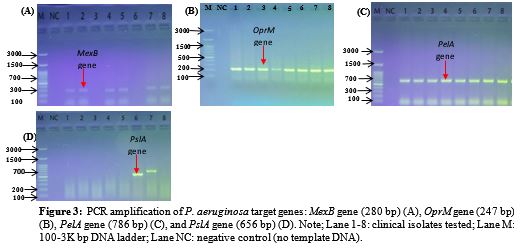
P. aeruginosa is a remarkable opportunistic bacterium that presents a significant issue in the therapeutic context, particularly within burn units. This is due to its capacity to produce catastrophic infections and apparent resistance to a variety of antimicrobial medications. The current study was designed to characterize clinical isolates of this bacterium from individuals suffering infections in their burn wounds in emergency hospitals in Erbil, Iraq. Isolates were recognized and analyzed via conventional microbiological approaches, automated VITEK® 2 system and molecular diagnostic techniques. Thirty isolates were collected and confirmed by amplification of the 16S rRNA gene. Antimicrobial drug susceptibility testing revealed high rates of resistance to several drugs, particularly ceftazidime, meropenem, gentamicin and ciprofloxacin. Molecular analysis revealed the existence of a large number of resistance genes coupled with efflux pumps, including OprM (90%), MexB (50%), MexR (43.3%) and MexA (36.6%). In addition, PelA and PslA genes associated with biofilm formation were found in all isolates (100%) and 30% of isolates, respectively. The findings underscore the critical need for ongoing molecular research on P. aeruginosa and the imperative to stop the dissemination of multidrug resistant species. The achievement of targeted infection handling strategies is essential
Full text article
References
Abbas, H. A., El-Ganiny, A. M., & Kamel, H. A. (2018). Phenotypic and genotypic detection of antibiotic resistance of Pseudomonas aeruginosa isolated from urinary tract infections. African health sciences, 18(1), 11-21. doi:https://doi.org/10.4314/ahs.v18i1.3
Abd El-Halim, N. Z. (2021). Phenotypic and molecular characteristics of Pseudomonas Aeruginosa isolated from burn unit. Egyptian Journal of Medical Microbiology, 30(1), 19-28. doi:https://doi.org/10.51429/EJMM30103
Abdulla, R. A. A.-r., & Abd Abo-risha, R. (2024). Evaluation of Some Efflux Pump Genes in Pseudomonas aeruginosa and their Relation to Antibiotic Resistance. Ibn AL-Haitham Journal for Pure and Applied Sciences, 37(4), 1-8. doi:https://doi.org/10.30526/37.4.3502
Al-Bayati, S. S., Al-Ahmer, S. D., Shami, A.-M. M., & Al-Azawi, A. H. (2021). Isolation and identification of Pseudomonas aeruginosa from clinical samples. Biochem Cell Arch, 21(2), 3931-3935. doi:https://connectjournals.com/03896.2021.21.3931
Al-Mashhadani, R., Aboksour, M., & Dakhil, O. (2024). Determine Biofilm Genes in Pseudomonas Aeruginosa Isolated from Clinical and Environmental Samples. Journal of Contemporary Medical Sciences, 10. doi:http://dx.doi.org/10.22317/jcms.v10i3.1557
Ali, S. S., Masyab, H. M., & Hasan, A. H. (2023). Bacterial Population of Alfalfa (Medicago Sativa L.) Plant Nodules in Koya City. Zanko Journal of Pure and Applied Science.doi: https://doi.org/10.21271/ZJPAS.35.4.23
Alsaadi, L. (2022). Molecular detection of the mex efflux pumps genes in extensively drug-resistatn and pandrug-resistant Pseudomonas aeruginosa isolated from Iraqi patients in Diyala. World Bull Public Health, 10, 97-105. doi:http://dx.doi.org/10.4103/MJBL.MJBL_294_23
Altaai, M. E., Aziz, I. H., & Marhoon, A. A. (2014). Identification Pseudomonas aeruginosa by 16s rRNA gene for Differentiation from Other Pseudomonas Species that isolated from Patients and environment. Baghdad Science Journal, 11(2), 107. doi:https://doi.org/10.21123/bsj.2014.11.2.1028-1034
Attallah AL-Mashhadani, R. K., AboKsour, M. F., & Azeez Dakhil, O. A. (2024). Determine Biofilm Genes in Pseudomonas aeruginosa Isolated from Clinical and Environmental Samples. Journal of Contemporary Medical Sciences, 10(3). doi:https://doi.org/10.22317/jcms.v10i3.1557
Avakh, A., Grant, G. D., Cheesman, M. J., Kalkundri, T., & Hall, S. (2023). The art of war with Pseudomonas aeruginosa: targeting Mex efflux pumps directly to strategically enhance antipseudomonal drug efficacy. Antibiotics, 12(8), 1304. doi:https://doi.org/10.3390/antibiotics12081304
Bakr, K. I., Abdul-Rahman, S. M., & Muhammad Hamasalih, R. (2022). Molecular detection of β-lactamase genes in Klebsiella pneumoniae and Escherichia coli isolated from different clinical sources. Cell and Molecular Biology, 67(4), 170-180. doi:http://dx.doi.org/10.14715/cmb/2021.67.4.19
Ciofu, O., & Tolker-Nielsen, T. (2019). Tolerance and resistance of Pseudomonas aeruginosa biofilms to antimicrobial agents—how P. aeruginosa can escape antibiotics. Frontiers in microbiology, 10, 913. doi:https://doi.org/10.3389/fmicb.2019.00913
Colvin, K. M., Irie, Y., Tart, C. S., Urbano, R., Whitney, J. C., Ryder, C., Parsek, M. R. (2012). The Pel and Psl polysaccharides provide Pseudomonas aeruginosa structural redundancy within the biofilm matrix. Environmental microbiology, 14(8), 1913-1928. doi:https://doi.org/10.1111/j.1462-2920.2011.02657.x
Darby, E. M., Trampari, E., Siasat, P., Gaya, M. S., Alav, I., Webber, M. A., & Blair, J. M. (2023). Molecular mechanisms of antibiotic resistance revisited. Nature Reviews Microbiology, 21(5), 280-295. doi:https://doi.org/10.1038/s41579-022-00820-y
Fernández-Billón, M., Llambías-Cabot, A. E., Jordana-Lluch, E., Oliver, A., & Macià, M. D. (2023). Mechanisms of antibiotic resistance in Pseudomonas aeruginosa biofilms. Biofilm, 5, 100129. doi:https://doi.org/10.1016/j.bioflm.2023.100129
Hamasalih, R., & Abdulrahman, Z. (2020). Antibiofilm potency of ginger (Zingiber officinale) and quercetin against staphylococcus aureus isolated from urinary tract catheterized patients. Applied Ecology and Environmental Research, 18(1), 219-236. doi:http://dx.doi.org/10.15666/aeer/1801_219236
Hasan, S. S., Said, L. A., & Hamed, S. L. (2020). Identification of clinical Pseudomonas spp. by VITEK 2 compact system and species-specific polymerase chain reaction assay for identification of Pseudomonas aeruginosa. Journal of Drug Delivery and Technology, 10(3), 383-388. doi:http://dx.doi.org/10.25258/ijddt.10.3.14
Jaafar, Z. M., Dhahi, M. A., Abd, A. K. H., & Jaafar, S. M. (2014). Molecular identification and antibiotics resistance genes profile of Pseudomonas aeruginosa isolated from Iraqi patients. African Journal of Microbiology Research, 8(21), 2183-2192. doi:http://dx.doi.org/10.5897/AJMR2013.6472
Jameel, Z. H., Alwash, M. S., & Abdulla, A. A. (2023). Molecular detection of efflux pump genes (MexAB-OprM) in Pseudomonas aeruginosa isolated form Babylon Province. Medical Journal of Babylon, 20(4), 732-738. doi:http://dx.doi.org/10.4103/MJBL.MJBL_294_23
Johnson, J. M., & Church, G. M. (1999). Alignment and structure prediction of divergent protein families: periplasmic and outer membrane proteins of bacterial efflux pumps. Journal of molecular biology, 287(3), 695-715. doi:https://doi.org/10.1006/jmbi.1999.2630
Karami, P., Khaledi, A., Mashoof, R. Y., Yaghoobi, M. H., Karami, M., Dastan, D., & Alikhani, M. Y. (2020). The correlation between biofilm formation capability and antibiotic resistance pattern in Pseudomonas aeruginosa. Gene Reports, 18, 100561. doi:https://doi.org/10.1016/j.genrep.2019.100561
khalid, H., Abdullah Mohammed Said, S., & Mohammed Salih Mero, W. (2023). Prevalence of Pseudomonas aeruginosa isolates and their antibiotic susceptibility among patients and healthcare workers in three Hospitals of Duhok city/ Iraq. Journal of Contemporary Medical Sciences, 9(5). doi:10.22317/jcms.v9i5.1428
Ozer, B., Duran, N., Onlen, Y., & Savas, L. (2012). Efflux pump genes and antimicrobial resistance of Pseudomonas aeruginosa strains isolated from lower respiratory tract infections acquired in an intensive care unit. The Journal of antibiotics, 65(1), 9-13. doi:https://doi.org/10.1038/ja.2011.102
Ozer, B., Duran, N., Onlen, Y., & Savas, L. (2012). Efflux pump genes and antimicrobial resistance of Pseudomonas aeruginosa strains isolated from lower respiratory tract infections acquired in an intensive care unit. J Antibiot (Tokyo), 65(1), 9-13. doi:10.1038/ja.2011.102
Polse, R., Khalid, H., & Mero, W. (2024). Molecular Identification and Detection of Virulence Genes Among Pseudomonas Aeruginosa Isolated from Burns Infections. Journal of Contemporary Medical Sciences, 10(1). doi:https://doi.org/10.22317/jcms.v10i1.1415
Sindeldecker, D., & Stoodley, P. (2021). The many antibiotic resistance and tolerance strategies of Pseudomonas aeruginosa. Biofilm, 3, 100056. doi:https://doi.org/10.1016/j.bioflm.2021.100056
Soares, A., Caron, F., & Etienne, M. (2019). Commentary: Tolerance and Resistance of Pseudomonas aeruginosa Biofilms to Antimicrobial Agents-How P. aeruginosa Can Escape Antibiotics. Frontiers in microbiology, Volume 10 - 2019. doi:10.3389/fmicb.2019.02164
Stapleton, F., & Carnt, N. (2012). Contact lens-related microbial keratitis: how have epidemiology and genetics helped us with pathogenesis and prophylaxis. Eye (Lond), 26(2), 185-193. doi:https://doi.org/10.1038/eye.2011.288
Turki. (2024). Pseudomonas aeruginosa: Isolation and Characterization. European Journal of Theoretical and Applied Sciences, 2, 446-464. doi:http://dx.doi.org/10.59324/ejtas.2024.2(3).35
Varela-Rodríguez, E., Arvizu Gómez, J., Martinez-Rizo, A., & Gonzalez-Reyes, C. (2023). Molecular identification of Pseudomonas aeruginosa and antibiotic resistance testing. GSC Biological and Pharmaceutical Sciences, 24, 308-316. doi:http://dx.doi.org/10.30574/gscbps.2023.24.2.0335
Wu, W., Huang, J., & Xu, Z. (2024). Antibiotic influx and efflux in Pseudomonas aeruginosa: Regulation and therapeutic implications. Microbial Biotechnology, 17(5), e14487. doi:https://doi.org/10.1111/1751-7915.14487
Younus, M. D., Bahjat, O. F., & Rashid, S. A. (2021). Antibiotic Susceptibility Pattern, Molecular Characterization of Virulence Genes among Pseudomonas Aeruginosa Isolated from Burn Patients. Cihan University-Erbil Scientific Journal, 5(1), 36-41. doi:https://doi.org/10.24086/cuesj.v5n1y2021.pp36-41
Authors
Copyright (c) 2026 Glena Qasim Faris, Karim Jalal Karim, and Hayman K. Mustafa

This work is licensed under a Creative Commons Attribution-NonCommercial-ShareAlike 4.0 International License.
Authors who publish with this journal agree to the following terms:
- Authors retain copyright and grant the journal right of first publication with the work simultaneously licensed under a Creative Commons Attribution License [CC BY-NC-SA 4.0] that allows others to share the work with an acknowledgment of the work's authorship and initial publication in this journal.
- Authors are able to enter into separate, additional contractual arrangements for the non-exclusive distribution of the journal's published version of the work, with an acknowledgment of its initial publication in this journal.
- Authors are permitted and encouraged to post their work online.