
EFFECTS OF SEMI-INSULATING GALLIUM ARSENIDE SUBSTRATE ORIENTATIONS AND SPIN COATING SPEED ON THE ELECTRICAL PERFORMANCE OF PANI/SI-GAAS HYBRID PHOTODETECTOR DEVICES

Article Sidebar
-
PANI, SI-GaAs orientation, Photodetector device, spin coating deposition, external quantum efficiency
Abstract
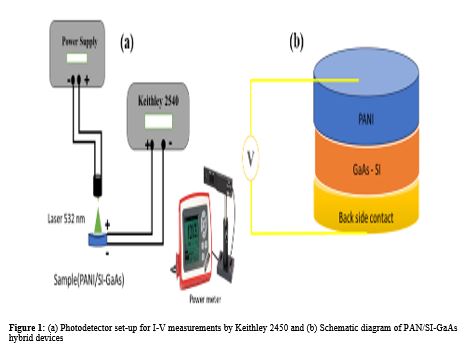
This article presents the influence of semi-insulating gallium arsenide (SI-GaAs) orientations and spin coating speed (rotation per minute, rpm) on the electrical performance of hybrid organic/inorganic photodetector devices. Hybrid polyaniline (PANI)/SI-GaAs/Ag photodetector devices were fabricated by depositing PANI thin films on (111) A and (111)B SI-GaAs substrates at speeds of 2000 rpm and 3000 rpm using the spin coating technique. Device performance, evaluated through current–voltage (I–V) measurements under dark conditions and illumination with 532 nm light at varying power intensities, revealed a notable dependence on both substrate orientation and spin speed. The PANI/(111)B SI-GaAs at 2000 rpm devices revealed optimal performance at 0.58 mW.cm-2 with a photo response ratio of 3.16, responsivity (R) of 0.362 mA/W, detectivity (D*) of 2.05x10⁹ Jones, and external quantum efficiency (EQE%) of 8.44x10⁻². The PANI/(111)B SI-GaAs devices fabricated at spin rates of 2000 rpm exhibit a decreasing trend in all three photodetector performance parameters with increasing light power intensity, while the PANI/(111)B SI-GaAs at 3000 rpm device increases slightly with increasing intensity, except at 0.75 mW·cm⁻², where it decreases. In contrast, the (111)A-based devices exhibited a consistent performance increase with rising light intensity from 0.58 mW.cm-2 to 1.52 mW.cm-2 across both spin rates. This approach of integrating organic and inorganic materials opens opportunities for producing flexible, high-performance, low-cost photodetectors for various optoelectronic applications
Full text article
References
essing, 171, 108020. https://doi.org/https://doi.org/10.1016/j.mssp.2023.108020
Hasan, M. B., Parvez, M. M., Abir, A. Y., & Ahmad, M. F. (2025). A review on conducting organic polymers: Concepts, applications, and potential environmental benefits. Heliyon, 11(3), e42375. https://doi.org/https://doi.org/10.1016/j.heliyon.2025.e42375
Ismail, M., Abdullah Ripain, A., Ahmad Fahri, M., Zulkifli, N., & Zakaria, R. (2023). Size-dependent of plasmonic gold nanoparticles enhanced on WS2/Si nanohybrids photodetector. Journal of Materials Science: Materials in Electronics, 34. https://doi.org/10.1007/s10854-023-10582-9
Ismail, M. N. S. M., Fahri, M. A. S. A., Tan, C. L., & Zakaria, R. (2025). Plasmon-enhanced visible photodetectors based on hexagonal boron nitride (hBN) with gold (Au), silver (Ag), and non-alloyed bimetallic (Au/Ag) nanoparticles. Scientific Reports, 15(1), 6. https://doi.org/10.1038/s41598-024-84337-9
Jameel, D. A. (2021). Electrical performance of organic/inorganic hybrid solar cell devices based on n-type GaAs substrate orientations and a conjugated polymer (PANI). Applied Physics A, 127(7), 570. https://doi.org/10.1007/s00339-021-04718-z
Jameel, D. A., Aziz, M., Felix, J. F., Al Saqri, N., Taylor, D., Albalawi, H., Alghamdi, H., Al Mashary, F., & Henini, M. (2016). Electrical performance of conducting polymer (SPAN) grown on GaAs with different substrate orientations. Applied Surface Science, 387, 228-236. https://doi.org/https://doi.org/10.1016/j.apsusc.2016.06.097
Jameel, D. A., Marroquin, J. F. R., Aziz, M., Al Saqri, N. A., Jum'h, I., Telfah, A., Henini, M., & Felix, J. F. (2020). Investigation of the effects of GaAs substrate orientations on the electrical properties of sulfonated polyaniline based heterostructures. Applied Surface Science, 504, 144315. https://doi.org/https://doi.org/10.1016/j.apsusc.2019.144315
Kamalasanan, M. N. (2011). Organic Semiconductors and its Applications. AIP Conference Proceedings, 1391(1), 23-26. https://doi.org/10.1063/1.3646770
Khan, J., Khan, A., Rubab, B., Jamshaid, F., Al-Kahtani, A. A., & Dahshan, A. (2023). Exploring the progression of energy storage toward flexibility: Metal-organic framework and conducting polymer aspects. Applied Materials Today, 34, 101906. https://doi.org/https://doi.org/10.1016/j.apmt.2023.101906
Koutsaroff, I., Edirisinghe, C. H., Ruda, H., Jedral, L. Z., Liu, Q., Guo-Ping, J., Xia, H., Lennard, W., & Rodriguez-Fernandez, L. (2011). Orientation Dependence Of Surface Passivation For Semi-Insulating Gaas. MRS Proceedings, 421. https://doi.org/10.1557/PROC-421-93
Kunkel, C., Margraf, J. T., Chen, K., Oberhofer, H., & Reuter, K. (2021). Active discovery of organic semiconductors. Nature Communications, 12(1), 2422. https://doi.org/10.1038/s41467-021-22611-4
L, Y., Niranjana, M., S P, A., H, V., S, R., & Hundekal, D. (2018). Characterization, Electrical Conductivity and Electrochemical Performance of Polyaniline-LiClO 4 -CuO Nano Composite for Energy Storage Applications. Polymer-Plastics Technology and Engineering, 58, 1-13. https://doi.org/10.1080/03602559.2018.1466175
Li, B., Wang, K., Zhao, N., Fu, Z., Wang, M., Xie, Z., & Li, J. (2024). A high-performance organic–inorganic self-powered broadband photodetector based on PANI/Bi2O2S nanocomposites [10.1039/D4TC02520B]. Journal of Materials Chemistry C, 12(44), 17986-17995. https://doi.org/10.1039/D4TC02520B
Liao, C., Xiong, Y., Fu, Y., Chen, X., & Occhipinti, L. G. (2025). Organic semiconductors based wearable bioelectronics. Wearable Electronics, 2, 23-39. https://doi.org/https://doi.org/10.1016/j.wees.2024.12.003
Liu, B., Xu, X., Han, M., Cheng, H., Chen, J., Sun, X., Zhang, Q., Duan, X., & Hu, J. (2023). Schottky junction made from a nanoporous Au and TiO2 film for plasmonic photodetectors. ACS Applied Nano Materials, 6(6), 4619-4625.
Liu, Y., Huang, W., Chen, W., Wang, X., Guo, J., Tian, H., Zhang, H., Wang, Y., Yu, B., Ren, T.-L., & Xu, J. (2019). Plasmon resonance enhanced WS2 photodetector with ultra-high sensitivity and stability. Applied Surface Science, 481, 1127-1132. https://doi.org/https://doi.org/10.1016/j.apsusc.2019.03.179
Lu, N., Li, L., Geng, D., & Liu, M. (2018). A review for polaron dependent charge transport in organic semiconductor. Organic Electronics, 61, 223-234.
Majeed, A. H., Mohammed, L. A., Hammoodi, O. G., Sehgal, S., Alheety, M. A., Saxena, K. K., Dadoosh, S. A., Mohammed, I. K., Jasim, M. M., & Salmaan, N. U. (2022). A Review on Polyaniline: Synthesis, Properties, Nanocomposites, and Electrochemical Applications. International Journal of Polymer Science, 2022(1), 9047554. https://doi.org/https://doi.org/10.1155/2022/9047554
Malhotra, B. D., & Ali, M. A. (2018). Chapter 4 - Biopolymeric Nanostructures: Biosensors and Bioimaging. In B. D. Malhotra & M. A. Ali (Eds.), Nanomaterials for Biosensors (pp. 127-144). William Andrew Publishing. https://doi.org/https://doi.org/10.1016/B978-0-323-44923-6.00004-2
Mustafa, H. A., Jameel, D. A., Salim, H. I., & Ahmed, S. M. (2020). The Effects Of N-GaAs Substrate Orientations on The Electrical Performance of PANI/N-GaAs Hybrid Solar Cell Devices. Science Journal of University of Zakho, 8(4), 149-153. https://doi.org/10.25271/sjuoz.2020.8.4.773
Pérez-Zenteno, F., García-Hemme, E., Torres, I., Barrio, R., Duarte, S., Benítez-Fernández, R., Caudevilla, D., García-Hernansanz, R., Olea, J., Pastor, D., Prado, A. d., & San Andrés, E. (2025). High-pressure sputtering deposition and in situ plasma oxidation of TiOx thin films as electron selective contact for photovoltaic applications. Materials Science in Semiconductor Processing, 186, 109038. https://doi.org/https://doi.org/10.1016/j.mssp.2024.109038
Rohizat, N. S., Ripain, A. H. A., Lim, C. S., Tan, C. L., & Zakaria, R. (2021). Plasmon-enhanced reduced graphene oxide photodetector with monometallic of Au and Ag nanoparticles at VIS–NIR region. Scientific Reports, 11(1), 19688. https://doi.org/10.1038/s41598-021-99189-w
Shafi, M., Mari, R. H., Khatab, A., Taylor, D., & Henini, M. (2010). Deep-level Transient Spectroscopy of GaAs/AlGaAs Multi-Quantum Wells Grown on (100) and (311)B GaAs Substrates. Nanoscale Research Letters, 5(12), 1948. https://doi.org/10.1007/s11671-010-9820-x
Shaker, S. S., Abdalsalam, A. H., & Ismail, R. A. (2024). Fabrication and characterization of polyaniline/Si heterojunction photodetector prepared by laser ablation in liquid. Journal of Optics. https://doi.org/10.1007/s12596-024-02160-x
Veale, M. C., Bell, S. J., Duarte, D. D., French, M. J., Schneider, A., Seller, P., Wilson, M. D., Lozinskaya, A. D., Novikov, V. A., Tolbanov, O. P., Tyazhev, A., & Zarubin, A. N. (2014). Chromium compensated gallium arsenide detectors for X-ray and γ-ray spectroscopic imaging. Nuclear Instruments and Methods in Physics Research Section A: Accelerators, Spectrometers, Detectors and Associated Equipment, 752, 6-14. https://doi.org/https://doi.org/10.1016/j.nima.2014.03.033
Watanabe, K., Taniguchi, T., & Kanda, H. (2004). Direct-bandgap properties and evidence for ultraviolet lasing of hexagonal boron nitride single crystal. Nature Materials, 3(6), 404-409. https://doi.org/10.1038/nmat1134
Yakuphanoglu, F., Başaran, E., Senkal, B., & Sezer, E. (2006). Electrical and Optical Properties of an Organic Semiconductor Based on Polyaniline Prepared by Emulsion Polymerization and Fabrication of Ag/Polyaniline/n-Si Schottky Diode. The journal of physical chemistry. B, 110, 16908-16913. https://doi.org/10.1021/jp060445v
Zanotti, L. (1983). Semi-insulating GaAs technology: Recent and future developments. Materials Chemistry and Physics, 9(1), 19-28. https://doi.org/https://doi.org/10.1016/0254-0584(82)90005-0
Authors
Copyright (c) 2026 Firas H. Ahmad, and Dler A. Jameel

This work is licensed under a Creative Commons Attribution-NonCommercial-ShareAlike 4.0 International License.
Authors who publish with this journal agree to the following terms:
- Authors retain copyright and grant the journal right of first publication with the work simultaneously licensed under a Creative Commons Attribution License [CC BY-NC-SA 4.0] that allows others to share the work with an acknowledgment of the work's authorship and initial publication in this journal.
- Authors are able to enter into separate, additional contractual arrangements for the non-exclusive distribution of the journal's published version of the work, with an acknowledgment of its initial publication in this journal.
- Authors are permitted and encouraged to post their work online.