
SE-CNN: A LIGHTWEIGHT DEEP LEARNING MODEL FOR ACUTE LYMPHOBLASTIC LEUKEMIA CLASSIFICATION

Article Sidebar
-
Squeeze and Excitation, Convolutional Neural Network, Medical image classification, Acute Lymphoblastic Leukemia, Peripheral blood smear
Abstract
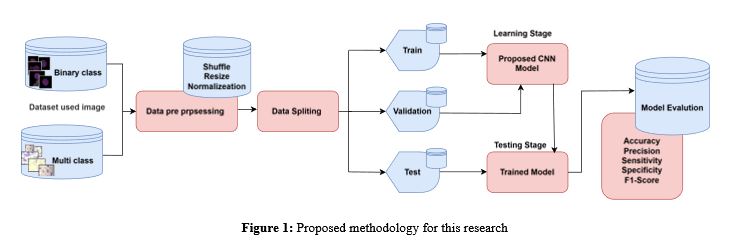
Leukemia is a potentially fatal hematological cancer that affects people of all ages and remains one of the leading causes of cancer death worldwide. It mostly impacts white blood cells (WBCs), which leads to the aberrant growth of immature lymphocytes that disrupt the bloodstream and bone marrow. Convolutional Neural Networks (CNNs), a type of deep learning, have become a potent instrument in medical image analysis in recent years, offering significant potential for automated and accurate disease classification. In this study, we present a lightweight CNN architecture enhanced with Squeeze-and-Excitation (SE) blocks for the classification of leukemia from peripheral blood smear images. The proposed model effectively captures channel-wise interdependencies to dynamically recalibrate feature responses, thereby improving the discrimination of relevant features. There were two publicly accessible datasets used for the experiments: C-NMC-2019 and Blood Cells Cancer (Acute Lymphoblastic Leukemia – ALL). The proposed model achieved an accuracy of 97.12% on the C-NMC-2019 dataset (binary classification) and 99.79% on the Blood Cells Cancer (ALL) dataset (multi-class classification). The results demonstrate that the proposed architecture achieves a strong trade-off between computational efficiency and classification accuracy, indicating its suitability for real-time, computer-aided leukemia diagnosis in clinical settings.
Full text article
References
Abioye, O. A., Evwiekpaefe, A. E., & Awujoola, A. J. (2024). Performance Evaluation of Efficientnetv2 Models on the Classification of Histopathological Benign Breast Cancer Images. Science Journal of University of Zakho, 12(2), 208–214. https://doi.org/10.25271/sjuoz.2024.12.2.1261
Agustin, R. I., Arif, A., & Sukorini, U. (2021). Classification of immature white blood cells in acute lymphoblastic leukemia L1 using neural networks particle swarm optimization. Neural Computing and Applications, 33(17), 10869–10880. https://doi.org/10.1007/s00521-021-06245-7
Alim, M. S., Bappon, S. D., Sabuj, S. M., Islam, M. J., Tarek, M. M., Azam, M. S., & Islam, M. M. (2024). Integrating convolutional neural networks for microscopic image analysis in acute lymphoblastic leukemia classification: A deep learning approach for enhanced diagnostic precision. Systems and Soft Computing, 6(July), 200121. https://doi.org/10.1016/j.sasc.2024.200121
Ananth, C., Tamilselvi, P., Joshy, S. A., & Kumar, T. A. (2023). Blood Cancer Detection with Microscopic Images Using Machine Learning. Lecture Notes in Networks and Systems, 498, 45–54. https://doi.org/10.1007/978-981-19-5090-2_4
Ansari, M. O., Ahmad, M. F., Shadab, G. G. H. A., & Siddique, H. R. (2018). Superparamagnetic iron oxide nanoparticles based cancer theranostics: A double edge sword to fight against cancer. Journal of Drug Delivery Science and Technology, 45, 177–183. https://doi.org/10.1016/j.jddst.2018.03.017
Anwar, S. M., Majid, M., Qayyum, A., Awais, M., Alnowami, M., & Khan, M. K. (2018). Medical Image Analysis using Convolutional Neural Networks: A Review. Journal of Medical Systems, 42(11). https://doi.org/10.1007/s10916-018-1088-1
Attallah, & Omneya. (2024). Acute lymphocytic leukemia detection and subtype classification via extended wavelet pooling based-CNNs and statistical-texture features. Image and Vision Computing, 147(August 2023), 105064. https://doi.org/10.1016/j.imavis.2024.105064
Bennett, J. M., Catovsky, D., Daniel, M. ‐T, Flandrin, G., Galton, D. A. G., Gralnick, H. R., & Sultan, C. (1976). Proposals for the Classification of the Acute Leukaemias French‐American‐British (FAB) Co‐operative Group. British Journal of Haematology, 33(4), 451–458. https://doi.org/10.1111/j.1365-2141.1976.tb03563.x
Bibi, N., Sikandar, M., Din, I. U., Almogren, A., & Ali, S. (2020). IOMT-based automated detection and classification of leukemia using deep learning. In Journal of Healthcare Engineering (Vol. 2020). https://doi.org/10.1155/2020/6648574
Brahmaiah, O. V., Raju, M. S. N., Jahnavi, V., & Varshini, M. (2024). Dense Net-Based Acute Lymphoblastic Leukemia Classification and Interpretation through Gradient-Weighted Class Activation Mapping. 2024 IEEE International Conference on Intelligent Techniques in Control, Optimization and Signal Processing, INCOS 2024 - Proceedings, 1–7. https://doi.org/10.1109/INCOS59338.2024.10527599
Bukhari, M., Yasmin, S., Sammad, S., & Abd El-Latif, A. A. (2022). A Deep Learning Framework for Leukemia Cancer Detection in Microscopic Blood Samples Using Squeeze and Excitation Learning. Mathematical Problems in Engineering, 2022. https://doi.org/10.1155/2022/2801227
Chen, Y. M., Chou, F. I., Ho, W. H., & Tsai, J. T. (2021). Classifying microscopic images as acute lymphoblastic leukemia by Resnet ensemble model and Taguchi method. BMC Bioinformatics, 22, 1–20. https://doi.org/10.1186/s12859-022-04558-5
Chiaretti, S., Zini, G., & Bassan, R. (2014). Diagnosis and subclassification of acute lymphoblastic leukemia. Mediterranean Journal of Hematology and Infectious Diseases, 6(1). https://doi.org/10.4084/mjhid.2014.073
Darmawan, S. T. S., & Shabrina, N. H. (2025). Explainable deep learning for diagnosing acute lymphocytic leukemia using blood smear images. Bulletin of Electrical Engineering and Informatics, 14(2), 1298–1307. https://doi.org/10.11591/eei.v14i2.9073
Das, P. K., Jadoun, P., & Meher, S. (2020). Detection and Classification of Acute Lymphocytic Leukemia. Proceedings of 2020 IEEE-HYDCON International Conference on Engineering in the 4th Industrial Revolution, HYDCON 2020. https://doi.org/10.1109/HYDCON48903.2020.9242745
Devi, J. R., Kadiyala, P. S., Lavu, S., Kasturi, N., & Kosuri, L. (2024). Enhancing Acute Lymphoblastic Leukemia Classification with a Rapid and Effective CNN Model. 3rd IEEE International Conference on Distributed Computing and Electrical Circuits and Electronics, ICDCECE 2024. https://doi.org/10.1109/ICDCECE60827.2024.10549348
Dubai, N. J., Kadhim, O. N., & Najjar, F. H. (2025). A Morphological Context Blocks Hybrid CNN for Efficient Acute Lymphoblastic Leukemia Classification. International Journal of Robotics and Control Systems, 5(2), 1102–1119. https://doi.org/10.31763/ijrcs.v5i2.1824
Dutta, M., Mojumdar, M. U., Kabir, A., Chakraborty, N. R., Siddiquee, S. T., & Abdullah, S. (2025). LEU3 : An Attention Augmented-Based Model for Acute Lymphoblastic Leukemia Classification. IEEE Access, 13(February), 31630–31642. https://doi.org/10.1109/ACCESS.2025.3542609
Erten, M., Barua, P. D., Dogan, S., Tuncer, T., Tan, R. S., & Acharya, U. R. (2024). ConcatNeXt: An automated blood cell classification with a new deep convolutional neural network. Multimedia Tools and Applications, 0123456789. https://doi.org/10.1007/s11042-024-19899-x
Hasanaath, A. A., Mohammed, A. S., Latif, G., Abdelhamid, S. E., Alghazo, J., & Hussain, A. A. (2024). Acute lymphoblastic leukemia detection using ensemble features from multiple deep CNN models. Electronic Research Archive, 32(4), 2407–2423. https://doi.org/10.3934/ERA.2024110
Hosseini, A., Eshraghi, M. A., Taami, T., Sadeghsalehi, H., Hoseinzadeh, Z., Ghaderzadeh, M., & Rafiee, M. (2023). A mobile application based on efficient lightweight CNN model for classification of B-ALL cancer from non-cancerous cells: A design and implementation study. Informatics in Medicine Unlocked, 39(April), 101244. https://doi.org/10.1016/j.imu.2023.101244
Hu, J., Shen, L., & Sun, G. (2018). Squeeze-and-excitation networks. Proceedings of the IEEE Conference on Computer Vision and Pattern Recognition, 7132–7141. https://doi.org/10.1109/QCE60285.2024.10249
Jawahar, M., H, S., L, J. A., & Gandomi, A. H. (2022). ALNett: A cluster layer deep convolutional neural network for acute lymphoblastic leukemia classification. Computers in Biology and Medicine, 148, 105894. https://doi.org/https://doi.org/10.1016/j.compbiomed.2022.105894
Kasani, P. H., Park, S. W., & Jang, J. W. (2020). An aggregated-based deep learning method for leukemic B-lymphoblast classification. Diagnostics, 10(12). https://doi.org/10.3390/diagnostics10121064
Mourya, S., Kant, S., Kumar, P., Gupta, A., & Gupta, R. (2019). ALL challenge dataset of ISBI 2019 (C-NMC-2019) (version 1) [dataset]. The Cancer Imaging Archive. https://doi.org/https://doi.org/10.7937/tcia.2019.dc64i46r
Muhsin, A. A., Atrushi, A. M., & Al-Doski, A. A. (2024). the Significance of Minimal Residual Disease in Acute Lymphoblastic Leukaemia: a Single Centre Study. Science Journal of University of Zakho, 12(2), 144–148. https://doi.org/10.25271/sjuoz.2024.12.2.1240
Nayak, R., Bekal, A., Suvarna, M., & Sathish, D. (2024). Identifying Subtypes of Acute Lymphoblastic Leukemia Using Blood Smear Images: A Hybrid Learning Approach. Journal of The Institution of Engineers (India): Series B, 0123456789. https://doi.org/10.1007/s40031-024-01069-0
Onciu, & Mihaela. (2009). Acute Lymphoblastic Leukemia. Hematology/Oncology Clinics of North America, 23(4), 655–674. https://doi.org/10.1016/j.hoc.2009.04.009
Prakash, K. D., Khan, J., & Kim, K. (2024). Lightweight and Efficient YOLOv8 with Residual Attention Mechanism for Precise Leukemia Detection and Classification. IEEE Access, 12(September), 159395–159413. https://doi.org/10.1109/ACCESS.2024.3484933
Pushpalatha, M. P., S, J. B., S, M., R, N. B., & K, A. (2024). Detection and Classification of Acute Lymphoblastic Leukemia using CNN. International Journal of Advanced Research in Computer Science, 15(4), 35–43. https://doi.org/10.26483/ijarcs.v15i4.7114
Rahman, W., Faruque, M. G. G., Roksana, K., Sadi, A. H. M. S., Rahman, M. M., & Azad, M. M. (2023). Multiclass blood cancer classification using deep CNN with optimized features. Array, 18(May), 100292. https://doi.org/10.1016/j.array.2023.100292
Saeed, U., Kumar, K., Khuhro, M. A., Laghari, A. A., Shaikh, A. A., & Rai, A. (2024). DeepLeukNet—A CNN based microscopy adaptation model for acute lymphoblastic leukemia classification. Multimedia Tools and Applications, 83(7), 21019–21043. https://doi.org/10.1007/s11042-023-16191-2
Salehi, H. S., Barchini, M., & Mahdian, M. (2020). Optimization methods for deep neural networks classifying OCT images to detect dental caries. Lasers in Dentistry XXVI, 11217, 16. https://doi.org/10.1117/12.2545421
Sampathila, N., Chadaga, K., Goswami, N., Chadaga, R. P., Pandya, M., Prabhu, S., Bairy, M. G., Katta, S. S., Bhat, D., & Upadya, S. P. (2022). Customized Deep Learning Classifier for Detection of Acute Lymphoblastic Leukemia Using Blood Smear Images. Healthcare (Switzerland), 10(10). https://doi.org/10.3390/healthcare10101812
Shah, B., & Bhavsar, H. (2022). Time Complexity in Deep Learning Models. Procedia Computer Science, 215(2022), 202–210. https://doi.org/10.1016/j.procs.2022.12.023
Shamama, A., & Afrin, A. (2020). A convolutional neural network–based learning approach to acute lymphoblastic leukaemia detection with automated feature extraction. Medical and Biological Engineering and Computing, 58(12), 3113–3121. https://doi.org/10.1007/s11517-020-02282-x
Suzuki, K. (2017). Overview of deep learning in medical imaging. Radiological Physics and Technology, 10(3), 257–273. https://doi.org/10.1007/s12194-017-0406-5
Zolfaghari, M., & Sajedi, H. (2022). A survey on automated detection and classification of acute leukemia and WBCs in microscopic blood cells. Multimedia Tools and Applications, 81(5), 6723–6753. https://doi.org/10.1007/s11042-022-12108-7
Authors
Copyright (c) 2026 Awaz Mustafa Abbas, Maiwan Bahjat Abdulrazaq, and Adel AL-Zebari

This work is licensed under a Creative Commons Attribution-NonCommercial-ShareAlike 4.0 International License.
Authors who publish with this journal agree to the following terms:
- Authors retain copyright and grant the journal right of first publication with the work simultaneously licensed under a Creative Commons Attribution License [CC BY-NC-SA 4.0] that allows others to share the work with an acknowledgment of the work's authorship and initial publication in this journal.
- Authors are able to enter into separate, additional contractual arrangements for the non-exclusive distribution of the journal's published version of the work, with an acknowledgment of its initial publication in this journal.
- Authors are permitted and encouraged to post their work online.