
OCCURRENCE AND IDENTIFICATION OF FUNGI ASSOCIATED WITH DRIED MEDICINAL PLANTS IN KURDISTAN REGION-IRAQ

Article Sidebar
-
Medicinal plants, Fungal contamination, Molecular identification, Phylogenetic analysis, ITS sequencing
Abstract
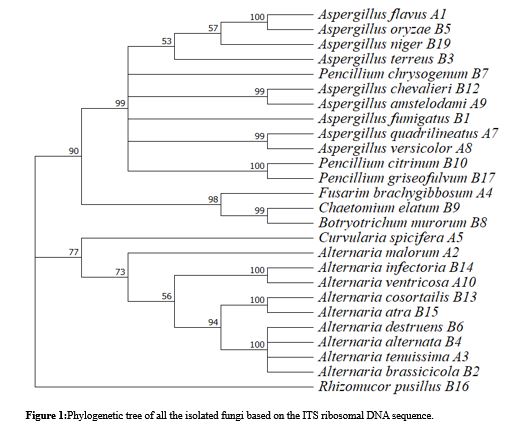
Medicinal plants are widely used in primary healthcare; however, they are frequently affected by fungal infections, posing health risks to users. This study is concerned with the isolation and identification of fungi found on five medicinal plants (Stinging nettle, Germander, Mesquite, Millepertuis scabre, and Hawthorn) bought from herbal shops in the cities of Duhok and Zakho, Iraq. Using moist blotting paper, direct plating methods, and genetic analysis, the current study found 26 different types of fungi from seven groups, including Penicillium, Aspergillus, and Alternaria. Aspergillus, Penicillium, and Alternaria were the predominant genera. The highest frequency was 67% for Botrytrichum murorum, 67% for Alternaria atra, and the lowest frequency was 4% for Penicillium, 7% for Alternaria, demonstrating considerable heterogeneity across plant types and collecting sites. The internal transcribed spacer (ITS) region, a commonly used DNA barcode for fungi, was used to identify the fungus. These findings offer essential insights into trends in fungal contamination and highlight the necessity of rigorous quality control protocols in the herbal medicinal plant supply chain.
Full text article
References
Abdullah, S., Al-Saad, I., & Essa, R. (2002). Mycobiota and natural occurrence of sterigmatocysin in herbal drugs in Iraq. Basrah J. Sci. B, 20(2), 1-8.
Abdullah, S. K., & Atrosh, H. I. M. (2014). New records of fungi on wheat grains from Iraq. Science Journal of University of Zakho, 2(2), 256-265.
Abdullah, S. K., Miryani, M. S., & Al-Saadoon, A. H. (2009). Mycobiota and incidence of aflatoxigenic Aspergillus section Flavi in three medicinal plants in Iraq. J. Duhok Univ, 12(1), 262-272.
Abdullah, S. K., & Nashat, L. H. (2014). Diversity of Soil Microfungi in Pine Forest at Duhok Governorate, Kurdistan Region, Iraq. Science Journal of University of Zakho, 2(1), 97-106.
Abed, R., Ibrahim, N., Hussein, R., AL-Khazreje, a., & Abbas, R. (2020). Investigation of fungi and mycotoxins contamination in some herbal slimming mixtures in Baquba city-Iraq. Microbial Biosystems, 5(1), 1-6. https://doi.org/10.21608/mb.2020.30860.1013
Adhikari, B. S., Babu, M., Saklani, P., & Rawat, G. (2010). Medicinal plants diversity and their conservation status in Wildlife Institute of India (WII) campus, Dehradun. Ethnobotanical leaflets, 2010(1), 6.
Ahmad, S., Zahiruddin, S., Parveen, B., Basist, P., Parveen, A., Gaurav, f., Parveen, R., & Ahmad, M. (2021). Indian medicinal plants and formulations and their potential against COVID-19–preclinical and clinical research. Frontiers in pharmacology, 11, 578970. https://doi.org/10.3389/fphar.2020.578970
Al-Zamel, F. A. (2009). Detection and diagnosis of Mycobacterium tuberculosis. Expert review of anti-infective therapy, 7(9), 1099-1108. https://doi.org/10.1586/eri.09.92
Ałtyn, I., & Twarużek, M. (2020). Mycotoxin contamination concerns of herbs and medicinal plants. Toxins, 12(3), 182. https://doi.org/10.3390/toxins12030182
Alvin, A., Miller, K. I., & Neilan, B. A. (2014). Exploring the potential of endophytes from medicinal plants as sources of antimycobacterial compounds. Microbiological research, 169(7-8), 483-495. https://doi.org/10.1016/j.micres.2013.12.009
Anderson, I. C., & Parkin, P. I. (2007). Detection of active soil fungi by RT-PCR amplification of precursor rRNA molecules. Journal of microbiological methods, 68(2), 248-253. https://doi.org/10.1016/j.mimet.2006.08.005
Areo, O. M., Phoku, J. Z., Gbashi, S., & Njobeh, P. B. (2020). A preliminary study of multi-mycotoxins contamination in some selected South Africa medicinal plants. Emirates Journal of Food and Agriculture, 32(6), 426-433.
Ashiq, S., Hussain, M., & Ahmad, B. (2014). Natural occurrence of mycotoxins in medicinal plants: a review. Fungal genetics and biology, 66, 1-10. https://doi.org/10.1016/j.fgb.2014.02.005
Bennett, J., & Klich, M. (2003). Mycotoxins. Clinical Microbiological Reviews, 16 (3), 497–516. Article CAS.
Benny, G. L., Humber, R. A., & Voigt, K. (2014). 8 Zygomycetous fungi: phylum entomophthoromycota and subphyla kickxellomycotina, mortierellomycotina, mucoromycotina, and zoopagomycotina. In Systematics and Evolution: Part A (209-250). Springer. https://doi.org/10.1007/978-3-642-55318-9_8
Caruso, G., Abdelhamid, M. T., Kalisz, A., & Sekara, A. (2020). Linking endophytic fungi to medicinal plants therapeutic activity. A case study on Asteraceae. Agriculture, 10(7), 286. https://doi.org/10.3390/agriculture10070286
Ellis, M. B. (1971). Dematiaceous hyphomycetes. Cabi.
Fang, K., Miao, Y.-F., Chen, L., Zhou, J., Yang, Z.-P., Dong, X.-F., & Zhang, H.-B. (2019). Tissue-specific and geographical variation in endophytic fungi of Ageratina adenophora and fungal associations with the environment. Frontiers in microbiology, 10, 2919. https://doi.org/10.3389/fmicb.2019.02919
Fontana, D. C., de Paula, S., Torres, A. G., de Souza, V. H. M., Pascholati, S. F., Schmidt, D., & Dourado Neto, D. (2021). Endophytic fungi: Biological control and induced resistance to phytopathogens and abiotic stresses. Pathogens, 10(5), 570. https://doi.org/10.3390/pathogens10050570
Frisvad, J. C., & Samson, R. A. (2004). Polyphasic taxonomy of Penicillium subgenus Penicillium. A guide to identification of food and air-borne terverticillate Penicillia and their mycotoxins. Studies in mycology, 49(1), 1-174.
Haleem, R. A., Saedo, K. A., & Abdullah, S. K. (2016). Antagonism of Trichoderma harzianum and Clonostachys rosea against fungi associated with grapevine decline in Kurdistan region-Iraq. Science Journal of University of Zakho, 4(2), 166-172.
Hope, R., Aldred, D., & Magan, N. (2005). Comparison of environmental profiles for growth and deoxynivalenol production by Fusarium culmorum and F. graminearum on wheat grain. Letters in applied microbiology, 40(4), 295-300. https://doi.org/10.1111/j.1472-765X.2005.01674.x
Houbraken, J., & Samson, R. (2011). Phylogeny of Penicillium and the segregation of Trichocomaceae into three families. Studies in mycology, 70(1), 1-51. https://doi.org/10.3114/sim.2011.70.01
Hussein, H. A., & Abdullah, S. K. (2017). Keratinolytic and Opportunistic Pathogenic Fungi from Carpet Dust in Mosques and Residentialhouses in Duhok, Kurdistan Region, Iraq. Science Journal of University of Zakho, 5(1), 16-19.
Klich, M. A. (2002). Identification of common Aspergillus species. Centraalbureau voor schimmelcultures.
Klich, M. A. (2009). Health effects of Aspergillus in food and air. Toxicology and Industrial Health, 25(9-10), 657-667. https://doi.org/10.1177/0748233709348271
Liu, D., Coloe, S., Baird, R., & Pedersen, J. (2000). Application of PCR to the identification of dermatophyte fungi. Journal of medical microbiology, 49(6), 493-497. https://doi.org/10.1099/0022-1317-49-6-493
Magan, N., & Aldred, D. (2007). Post-harvest control strategies: minimizing mycotoxins in the food chain. International journal of food microbiology, 119(1-2), 131-139. https://doi.org/10.1016/j.ijfoodmicro.2007.07.034
Mahesh, B., & Satish, S. (2008). Antimicrobial activity of some important medicinal plant against plant and human pathogens. World journal of agricultural sciences, 4(5), 839-843. https://doi.org/10.1080/22311866.2012.10719105
Ndoro, J., Manduna, I. T., Nyoni, M., & de Smidt, O. (2022). Multiple mycotoxin contamination in medicinal plants frequently sold in the free state province, South Africa detected using UPLC-ESI-MS/MS. Toxins, 14(10), 690. https://doi.org/10.3390/toxins14100690
O'Donnell, K., Sutton, D. A., Fothergill, A., McCarthy, D., Rinaldi, M. G., Brandt, M. E., Zhang, N., & Geiser, D. M. (2008). Molecular phylogenetic diversity, multilocus haplotype nomenclature, and in vitro antifungal resistance within the Fusarium solani species complex. Journal of Clinical Microbiology, 46(8), 2477-2490.
Ojah, E. O., Oladele, E. O., & Chukwuemeka, P. (2021). Phytochemical and antibacterial properties of root extracts from Portulaca oleracea Linn.(Purslane) utilised in the management of diseases in Nigeria. Journal of Medicinal Plants for Economic Development, 5(1), 103. https://doi.org/10.4102/jomped.v5i1.103
Okaiyeto, K., & Oguntibeju, O. O. (2021). African herbal medicines: Adverse effects and cytotoxic potentials with different therapeutic applications. International journal of environmental research and public health, 18(11), 5988. https://doi.org/10.3390/ijerph18115988
Othman, I. M., Mahross, M. H., Gad-Elkareem, M. A., Rudrapal, M., Gogoi, N., Chetia, D., Aouadi, K., Snoussi, M., & Kadri, A. (2021). Toward a treatment of antibacterial and antifungal infections: Design, synthesis and in vitro activity of novel arylhydrazothiazolylsulfonamides analogues and their insight of DFT, docking and molecular dynamic simulations. Journal of Molecular Structure, 1243, 130862. https://doi.org/10.1016/j.molstruc.2021.130862
Ozioma, E.-O. J., & Chinwe, O. A. N. (2019). Herbal medicines in African traditional medicine. In Herbal medicine. IntechOpen.
Paterson, R., Venâncio, A., & Lima, N. (2003). Mycotoxins-the experience and expertise of Micoteca da Universidade do Minho.
Pitt, J. I., & Hocking, A. D. (2009). Fungi and food spoilage (Vol. 519). Springer.
Porras-Alfaro, A., & Bayman, P. (2011). Hidden fungi, emergent properties: endophytes and microbiomes. Annual review of phytopathology, 49(1), 291-315. https://doi.org/10.1146/annurev-phyto-080508-081831
Saadullah, A. A. M., & A bdullah, S. K. (2018). Fungal contamination of dried vine fruits and ochratoxin a detection in grape juice from Duhok, Iraq. Innovaciencia, 6(2), 1-8. https://doi.org/10.15649/2346075X.472
Salmerón-Manzano, E., Garrido-Cardenas, J. A., & Manzano-Agugliaro, F. (2020). Worldwide research trends on medicinal plants. International journal of environmental research and public health, 17(10), 3376. https://doi.org/10.3390/ijerph17103376
Samson, R. A., Visagie, C. M., Houbraken, J., Hong, S. B., Hubka, V., Klaassen, C. H., Perrone, G., Seifert, K. A., Susca, A., & Tanney, J. B. (2014). Phylogeny, identification, and nomenclature of the genus Aspergillus. Studies in mycology, 78(1), 141–173. https://doi.org/10.1016/j.simyco.2014.07.004
Schoch, C. L., Seifert, K. A., Huhndorf, S., Robert, V., Spouge, J. L., Levesque, C. A., Chen, W., Consortium, F. B., List, F. B. C. A., & Bolchacova, E. (2012). Nuclear ribosomal internal transcribed spacer (ITS) region as a universal DNA barcode marker for Fungi. Proceedings of the national academy of Sciences, 109(16), 6241-6246.
Sevindik, E., Sarsenova, A. N., Abievich, A. S., Sofyalioğlu, E., Esenomanovna, D. T., & Eken, C. (2022). Phylogenetic analysis of some fungi species in West Kazakhstan based on nuclear ribosomal DNA ITS sequences. Notulae Botanicae Horti Agrobotanici Cluj-Napoca, 50(3), 12783-12783. https://doi.org/10.15835/nbha50312783
Simmons, E. G. (1986). Alternaria themes and variations 22-26.
Singh, D., Rathod, V., Singh, A., Joshi, R., Nagaratna, H., & Avinash, B. (2015). Antibacterial activity and phytochemical analysis of the crude extracts of endophytic fungus, Alternaria sp. from the medicinal plant Euphorbia hirta (L). Int J Green Chem Bioproc, 5, 14-20.
Snowden, A. L. (2010). Post-harvest diseases and disorders of fruits and vegetables: volume 2: vegetables (Vol. 2). CRC Press. https://doi.org/10.1201/b18215
Tamura, K., Stecher, G., & Kumar, S. (2021). MEGA11: molecular evolutionary genetics analysis version 11. Molecular biology and evolution, 38(7), 3022-3027. https://doi.org/10.1093/molbev/msab120
Tiwari, R. S., Chandra, K. K., Dubey, S., & Tripathi, S. (2022). Influence of packaging materials and storage conditions on seed germination ability and biochemical changes in some medicinal plants of Indian forests. Frontiers in Forests and Global Change, 5, 868237. https://doi.org/10.3389/ffgc.2022.868237
Toma, F. M., & Abdulla, N. Q. F. (2013). Isolation and identification of fungi from spices and medicinal plants. Research Journal of Environmental and Earth Sciences, 5(3), 131-138. https://doi.org/10.19026/rjees.5.5648
Trail, F. (2007). Fungal cannons: explosive spore discharge in the Ascomycota. FEMS microbiology letters, 276(1), 12-18. https://doi.org/10.1111/j.1574-6968.2007.00900.x
Tsipinana, S., Husseiny, S., Alayande, K. A., Raslan, M., Amoo, S., & Adeleke, R. (2023). Contribution of endophytes towards improving plant bioactive metabolites: a rescue option against red-taping of medicinal plants. Frontiers in plant science, 14, 1248319. https://doi.org/10.3389/fpls.2023.1248319
Ur Rehman, F., Kalsoom, M., Adnan, M., Fazeli-Nasab, B., Naz, N., Ilahi, H., Ali, M. F., Ilyas, M., Yousaf, G., & Toor, M. D. (2021). Importance of medicinal plants in human and plant pathology: a review. International Journal of Pharmacology and Biomedical Research, 8, 1-11.
Verkley, G., Dukik, K., Renfurm, R., Göker, M., & Stielow, J. (2014). Novel genera and species of coniothyrium-like fungi in Montagnulaceae (Ascomycota). Persoonia-Molecular Phylogeny and Evolution of Fungi, 32(1), 25-51. https://doi.org/10.3767/003158514X679191
Wang, G., Jiao, M., Hu, J., Xun, Y., Chen, L., Qiu, J., Ji, F., Lee, Y.-W., Shi, J., & Xu, J. (2024). Quantitative analysis of fungal contamination of different herbal medicines in China. Toxins, 16(5), 229. https://doi.org/10.3390/toxins16050229
Weideman, L. (2005). An investigation into the antibacterial activities of medicinal plants traditionally used in the Eastern Cape to treat secondary skin infections associated with burn wounds Nelson Mandela Metropolitan University.
White, T. J., Bruns, T., Lee, S., & Taylor, J. (1990). Amplification and direct sequencing of fungal ribosomal RNA genes for phylogenetics. PCR protocols: a guide to methods and applications, 18(1), 315-322.
WHO. (2003). WHO guidelines on good agricultural and collection practices [GACP] for medicinal plants. World Health Organization.
Woudenberg, J. H. C., Seidl, M. F., Groenewald, J. Z., De Vries, M., Stielow, J. B., Thomma, B. P. H. J., & Crous, P. W. (2015). Alternaria section Alternaria: Species, formae speciales or pathotypes? Studies in mycology, 82(1), 1-21. https://doi.org/10.1016/j.simyco.2015.07.001
Wyk, B. v., Oudtshoorn, B. v., & Gericke, N. (1997). Medicinal Plants of South Africa.
Zagal, D., Graham, J. G., Bisson, J., Green, S. J., & Pauli, G. F. (2024). Medicinal plant microbiomes: factors affecting bacterial and fungal community composition. Planta Medica, 90(15), 1130-1142. https://doi.org/10.1055/a-2420-0270
Zhang, N., Castlebury, L. A., Miller, A. N., Huhndorf, S. M., Schoch, C. L., Seifert, K. A., Rossman, A. Y., Rogers, J. D., Kohlmeyer, J., & Volkmann-Kohlmeyer, B. (2006). An overview of the systematics of the Sordariomycetes based on a four-gene phylogeny. Mycologia, 98(6), 1076-1087. https://doi.org/10.1080/15572536.2006.11832635
Authors
Copyright (c) 2026 Kawthar R. Hussein, and Raed A. Haleem

This work is licensed under a Creative Commons Attribution-NonCommercial-ShareAlike 4.0 International License.
Authors who publish with this journal agree to the following terms:
- Authors retain copyright and grant the journal right of first publication with the work simultaneously licensed under a Creative Commons Attribution License [CC BY-NC-SA 4.0] that allows others to share the work with an acknowledgment of the work's authorship and initial publication in this journal.
- Authors are able to enter into separate, additional contractual arrangements for the non-exclusive distribution of the journal's published version of the work, with an acknowledgment of its initial publication in this journal.
- Authors are permitted and encouraged to post their work online.