
PHYTOCHEMICAL PROFILE, ANTIBACTERIAL and ANTIBIOFILM ACTIVITIES OF SOLVENT EXTRACTS OF Vernonia amygdalina

Article Sidebar
-
AMR, Antibacterial activity, Antibiofilm activity, phytochemical constituents, Vernonia amygdalina
Abstract
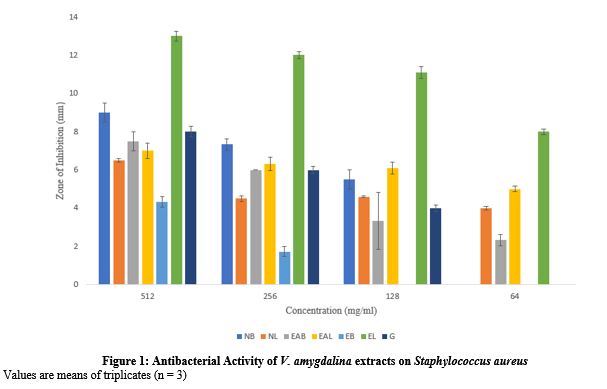
This study was conducted to determine the antibiofilm and antibacterial potential of Vernonia amygdalina leaf and bark against Pseudomonas aeruginosa, Klebsiella pneumoniae and Staphylococcus aureus. The secondary metabolites in V. amygdalina were extracted using ethyl acetate, n-hexane and ethanol solvents and evaluated through phytochemical analysis. Antibacterial activity of the extracts was determined through agar well diffusion while broth microdilution was used for the minimum inhibitory concentration (MIC). The pour plate technique was employed for the minimum bactericidal concentration (MBC). Biofilm formation was established and antibiofilm activity was evaluated using the ρ-iodonitrotetrazolium colorimetric assay. The phytochemical screening indicated saponin as the only compound in the leaf while saponin, flavonoids, alkaloids, phenolics and triterpenes were present in the bark. Ethyl acetate exhibited the highest antibacterial activity at the least concentration. It had MIC values between 8–16 µg/mL with an inhibition of biofilm at a rate of 87.96% especially against K. pneumoniae. The ethanol extract had a moderate antimicrobial effect and that of n-hexane was negligible. The result shows that polar solvents like ethyl acetate are effective for extracting antimicrobial agents from V. amygdalina. They also highlight V. amygdalina as an effective natural agent against biofilm-forming and antibiotic resistant pathogens.
Full text article
References
Adeoye, A. T., Akinrinde, A. S., Oyagbemi, A. A., Omobowale, T. O., Adedapo, A. D. A., Ayodele, E. A., Yakubu, M. A., & Adedapo, A. A. (2018). Phytochemical, analgesic, in vitro antioxidant and GC-MS analysis of Vernonia amygdalina leaves. African Journal of Biomedical Research, 21(3), 303–310. DOI: 10.4314/
Adeniyi, A., & Abubakar, I. M. (2020). Impact of Climate Variability on Food Availability in Kwara State, Nigeria. Osun Geographical Review, 3(1). Retrieved from https://journals.uniosun.edu.ng/ogr/article/view/132
Barbarossa, A., Rosato, A., Tardugno, R., Carrieri, A., Corbo, F., Limongelli, F., Fumarola, L., Fracchiolla, G., & Carocci, A. (2025). Antibiofilm effects of plant extracts against Staphylococcus aureus. Microorganisms, 13(2), 454. DOI: 10.3390/microorganisms13020454
Bibi, N., Perveen, S., Kanwal, S., Latif, F., Rashid, R., Janiad, S., Qadeer, I., Naseem, F., Alanzi, A. R., Herqash, R. N., Haider, I., Abbasov, M. A., Kayani, S., Shah, M. A. (2025). Investigation of Antimicrobial Potential of Medicinal Plants Against Pseudomonas aeruginosa. Food Science & Nutrition, 13(11). DOI: 10.1002/fsn3.70999.
Clinical and Laboratory Standards Institute. (2022). Performance standards for antimicrobial susceptibility testing (32nd ed., CLSI supplement M100). CLSI.
Cowan, M. M. (1999). Plant products as antimicrobial agents. Clinical Microbiology Reviews, 12(4), 564–582. DOI: 10.1128/CMR.12.4.564
Degu, S., Meresa, A., Animaw, Z., Jegnie, M., Asfaw, A., & Tegegn, G. (2024). Vernonia amygdalina: A comprehensive review of the nutritional makeup, traditional medicinal use, and pharmacology of isolated phytochemicals and compounds. Frontiers in Natural Products, 3, 1347855. DOI: 10.3389/fnpr.2024.1347855
Edo, G. I., Samuel, P. O., Jikah, A. N., Onoharigho, F. O., Idu, L. I., Obasohan, P., Opiti, A. R., Electric, J., Ikpekoro, V. O., Otunuya, C. F., Ugbuwe, E., Ongulu, J., Ijide, M., Nwaose, I. D., Ajakaye, S. R., & Owigho, J. E. (2023). Biological and bioactive components of bitter leaf (Vernonia amygdalina leaf): Insight on health and nutritional benefits. Food Chemistry Advances, 3, 100488. DOI: 10.1016/j.focha.2023.100488
Ferraz, M. P. (2024). Antimicrobial resistance: The impact from and on society according to One Health approach. Societies, 14, 187. DOI: 10.3390/societies14100187
Gonçalves, A. S. C., Leitão, M. M., Simões, M., & Borges, A. (2023). The action of phytochemicals in biofilm control. Natural Product Reports, 40(3), 595–627. DOI: 10.1039/D2NP00053A
Harborne, J. B. (1998). Phytochemical methods: A guide to modern techniques of plant analysis (3rd ed.). Chapman & Hall.
Inusa, A., Sanusi, S. B., Linatoc, A. C., Mainassara, M. M., & Awawu, J. J. (2018). Phytochemical analysis and antimicrobial activity of bitter leaf (Vernonia amygdalina) collected from Lapai, Niger State, Nigeria on some selected pathogenic microorganism. Scientific World Journal, 13, 15–18. https://www.ajol.info/index.php/swj/article/download/183577/172933
Jangpangi, D., Patni, B., Chandola, V., & Chandra, S. (2025). Medicinal plants in a changing climate: Understanding the links between environmental stress and secondary metabolite synthesis. Frontiers in Plant Science, 16, 1587337. DOI: 10.3389/fpls.2025.1587337
Joseph, J., Boby, S., & Muyyarikkandy, M. S. (2025). Phytochemicals: A Promising Strategy to Combat Biofilm-Associated Antimicrobial Resistance. Exploring Bacterial Biofilms. DOI: 10.5772/intechopen.1009478
Kupina, S. A., Romanova, N. A., & Tikhonov, V. P. (2018). Triterpenoids in plant extracts and their antimicrobial properties. Pharmaceutical Chemistry Journal, 52(3), 203–208. DOI: 10.1007/s11094-018-1787-2
Le Bot, M., Thibault, J., Pottier, Q., Boisard, S., & Guilet, D. (2022). An accurate, cost-effective and simple colorimetric method for quantification of total triterpenoid and steroidal saponins. Food Chemistry, 380, 132132. DOI: 10.1016/j.foodchem.2022.132132
Mancuso, G., Midiri, A., Gerace, E., & Biondo, C. (2021). Bacterial antibiotic resistance: The most critical pathogens. Pathogens, 10(10), 1310. DOI: 10.3390/pathogens10101310
Narayanan, M., Chanthini, A., Devarajan, N., Saravanan, M., Sabour, A., Alshiekheid, M., Chi, N. T. L., & Brindhadevi, K. (2023). Antibacterial and antioxidant efficacy of ethyl acetate extract of Cymodocea serrulata and assess the major bioactive components in the extract using GC-MS analysis. Process Biochemistry, 124, 24–32. DOI: 10.1016/j.procbio.2022.10.036
Nkwocha, C. C., Felix, J. O., Michael, L. O., & Ale, B. A. (2024). Phytochemical screening and GC-FID identification of bioactive compounds in n-hexane, ethylacetate and methanol fractions of methanolic leaves extract of Azanza garckeana. Food Chemistry Advances, 4, 100712. DOI: 10.1016/j.focha.2024.100712
Okolie, N. P., & Osagie, A. U. (2020). Antibacterial properties of Vernonia amygdalina bark extracts. Journal of Ethnopharmacology, 259, 112977. DOI: 10.1016/j.jep.2020.112977
Onifade, A. K., Akinyemi, D. D., & Ogundare, A. O. (2024). Antibacterial activities of Vernonia amygdalina stem bark extracts on multiple antibiotic-resistant bacteria isolated from wound samples. Microbes and Infectious Diseases, 5, 1–10. DOI: 10.21608/mid.2024.256041
Pang, Z., Raudonis, R., Glick, B. R., Lin, T. J., & Cheng, Z. (2019). Antibiotic Resistance in Pseudomonas aeruginosa: Mechanisms and Alternative Therapeutic Strategies. Biotechnology Advances, 37(1), 177–192. DOI: 10.1016/j.biotechadv.2018.11.013
Rao, M. S., Banerjee, T., & Joshi, H. V. (2023). Therapeutic relevance of phenolic compounds in traditional medicine: Mechanisms and potential applications. Frontiers in Pharmacology, 14, 1023456. DOI: 10.3389/fphar.2023.1023456
Romano, E., Domínguez-Rodríguez, G., Mannina, L., Cifuentes, A., & Ibáñez, E. (2025). Characterization of Non-Polar and Polar Bioactive Compounds Obtained by Pressurized Biobased Solvents from Different Arctium lappa L. Root Ecotypes. Applied Sciences, 15(5), 2491–2491. DOI: 10.3390/app15052491
Sathish, J. V., Reddy, K. R. M., & Sujith, P. (2017). Tube adherence test as a screening tool for detection of biofilm formation among Staphylococcus. Indian Journal of Microbiology Research, 4(3), 257–260. DOI: 10.18231/2394-5478 .2017.0009
Sileshi, D., Asfaw, M., Zelalem, A., Mihretu, J., Asaye, A., & Getachew, T. (2024). Vernonia amygdalina: A comprehensive review of the nutritional makeup, traditional medicinal use, and pharmacology of isolated phytochemicals and compounds. Frontiers in Natural Products, 3, 1. DOI: 10.3389/fnpr.2024.1347855
Suresh, R., Kumar, A., Patel, V., & Sharma, P. (2021). Phytochemical analysis and pharmacological potential of medicinal plants: A review. Journal of Ethnopharmacology, 275, 114116. DOI: 10.1016/j.jep.2021.114116
Talwar, A., Chakraborty, N., Zahera, M., Anand, S., Ahmad, I., Siddiqui, S., Nayyar, A., Haque, A., & Saeed, M. (2024). Antidiabetic potential of phytochemicals found in Vernonia amygdalina. Journal of Chemistry, 1–12. DOI: 10.1155/2024/8894123
Trease, G. E., & Evans, W. C. (2009). Pharmacognosy (16th ed.). Saunders Elsevier.
Udochukwu, U., Omeje, F., Uloma, I. S. Oseiwe, F. D. (2015). Phytochemical analysis of Vernonia Amygdalina and Ocimum Gratissimum extracts And their antibacterial activity on some drug resistant bacteria. American Journal Of Research Communication, 3(5), 225-235. http://www.usa-journals.com/wp-content/uploads/2015/04/Udochukwu_Vol35.pdf
World Health Organization. (2023). Antimicrobial resistance. World Health Organization.
Xu, J. W., Yang, N., Shi, F. X., Zhang, Y., Wan, S., & Mao, R. (2022). Bark controls tree branch-leached dissolved organic matter production and bioavailability in a subtropical forest. Biogeochemistry, 158(3), 345–355. DOI: 10.1007/s10533-022-00944-5
Zakariyah, R. F., Ahmed, R. N., Ajijolakewu, K. A., & Hamid, A. A. (2025). Enhanced antibacterial potential of fractionated bioactive compounds isolated from endophytic Nigrospora oryzae UILRZ1 in Ocimum gratissimum. Journal of Tropical Biodiversity and Biotechnology, 10, 1–12. DOI: 10.22146/jtbb.92211
Zakariyah, R. F., Sani, A., & Odebisi-Omokanye, M. B. (2017). Screening of Prosopis africana for antimicrobial activity against oral pathogens. Nigerian Journal of Pure and Applied Sciences, 30, 3049–3058. DOI: 10.19240/njpas.2017.B05
Zhou, J., Bi, S., Chen, H., Chen, T., Yang, R., Li, M., Fu, Y., & Jia, A. Q. (2017). Anti-biofilm and antivirulence activities of metabolites from Plectosphaerella cucumerina against Pseudomonas aeruginosa. Frontiers in Microbiology, 8, 769. DOI: 10.3389/fmicb.2017.00769.
Authors
Copyright (c) 22026 Rahmat F. Zakariyah, Oluwakemi P. Ojelakin, Oluwaseun E. Olorunfemi, Waliyullahi A. Husain, and Elohor P. Samuel

This work is licensed under a Creative Commons Attribution-NonCommercial-ShareAlike 4.0 International License.
Authors who publish with this journal agree to the following terms:
- Authors retain copyright and grant the journal right of first publication with the work simultaneously licensed under a Creative Commons Attribution License [CC BY-NC-SA 4.0] that allows others to share the work with an acknowledgment of the work's authorship and initial publication in this journal.
- Authors are able to enter into separate, additional contractual arrangements for the non-exclusive distribution of the journal's published version of the work, with an acknowledgment of its initial publication in this journal.
- Authors are permitted and encouraged to post their work online.