
COMPARATIVE ANALYSIS OF CNN FOR FINANCIAL FRAUD DETECTION ON TABULAR TRANSACTION DATA

Article Sidebar
-
Deep Learning, Feature Reshaping, Financial Cyber-security, Convolutional Neural Networks
Abstract
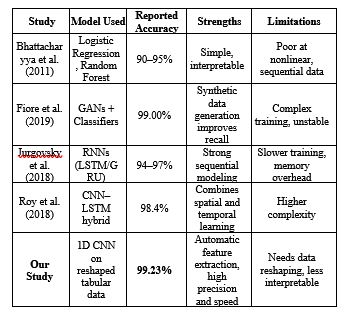
Financial Fraud threatens global financial stability gravely. Fraud comes with important economic losses and has negative effects on public trust. Traditional rule-based systems and older methods of machine learning cannot detect these patterns of fraud, especially when facing complex or continuously changing fraud patterns in the era of high-speed and high-volume transactions. This research proposes a deep learning technique for the detection of financial fraud by using Convolutional Neural Networks on reshaped tabular transaction data. The proposed CNN model utilizes spatial feature extraction by reprocessing 1D financial records into 2D matrices. This method aims in recognizing local relationships among features as indicative of fraudulent activity. Preprocessing steps for this proposed system include class balancing, scaling of features, and one-hot encoding. It is tested on a highly imbalanced credit card fraud dataset from Kaggle. Then, the classification accuracy was 99.23%. An accuracy of 98.6%, a recall of 97.9%, an F1-score of 98.25%, and an AUC-ROC of 0.992 were also reported. These results indicate that the CNN model can capture the hidden patterns of fraud well when compared to traditional methods. Furthermore, they are less dependent on manual feature engineering and adaptive to evolving fraud strategies.
Full text article
References
ACFE (2022). Report to the Nations: 2022 Global Study on Occupational Fraud and Abuse. Association of Certified Fraud Examiners.
Ahmed, S., Rahman, M., & Islam, M. (2023). Benchmarking machine learning algorithms for real-time fraud detection: A comparative analysis. Journal of Financial Data Science, 5(2), 78-95.
Bhattacharyya, S., Jha, S., Tharakunnel, K., & Westland, J. C. (2011). Data mining for credit card fraud: A comparative study. Decision Support Systems, 50(3), 602–613. https://doi.org/10.1016/j.dss.2010.08.008
Bolton, R. J., & Hand, D. J. (2002). Statistical fraud detection: A review. Statistical Science, 17(3), 235–255. https://doi.org/10.1214/ss/1042727940
Chen, R. C., Huang, Y. H., & Lin, Y. H. (2004). A new binary classification method for imbalanced data sets using logistic regression and decision trees. Journal of Information Science and Engineering, 20, 125–134.
Dal Pozzolo, A., Caelen, O., Johnson, R. A., & Bontempi, G. (2018). Calibrating probability with undersampling for unbalanced classification. 2015 IEEE Symposium Series on Computational Intelligence, 159–166. https://doi.org/10.1109/SSCI.2015.33
Fahim, A., Osman, A. M., Tarek, Z., & Elshewey, A. M. (2025). Credit card fraud detection based on a hybrid CNN RNN deep learning model. Engineering, Technology & Applied Science Research, 15(6), 28836–28842. https://doi.org/10.48084/etasr.13938
Faye, E., & Zhang, W. (2024). Enhancing financial fraud detection: The efficacy of convolutional neural networks. Journal of Computer Science and Software Applications, 4(7), 25–35. Retrieved from: https://mfacademia.org/index.php/jcssa/article/view/173
Fiore, U., De Santis, A., Perla, F., Zanetti, P., & Palmieri, F. (2019). Using generative adversarial networks for improving classification effectiveness in credit card fraud detection. Information Sciences, 479,448–455.
Hafez, I. Y., Hafez, A. Y., Saleh, A., Abd El Mageed, A. A., & Abohany, A. A. (2025). A systematic review of AI enhanced techniques in credit card fraud detection. Journal of Big Data, 12(6). https://doi.org/10.1186/s40537-024-01048-8
Hasan, M., Rahman, A., & Ahmed, T. (2023). XGBoost and random forest ensemble for imbalanced credit card fraud detection. Expert Systems with Applications, 215, 119345.
Hassan, Y. A., & Kareem, O. S. (2025). Credit card fraud detection: A comparative study of machine learning and deep learning methods. Engineering and Technology Journal, 10(5). https://doi.org/10.47191/etj/v10i05.45
He, K., Zhang, X., Ren, S., & Sun, J. (2022). Deep residual learning for fraud detection: A comprehensive study. Journal of Machine Learning Research, 23(1), 1-28. https://doi.org/10.1016/j.ins.2018.02.060
Jurgovsky, J., Granitzer, M., Ziegler, K., Calabretto, S., Portier, P. E., He-Guelton, L., & Caelen, O. (2018). Sequence classification for credit-card fraud detection. Expert Systems with Applications, 100, 234–245.
https://doi.org/10.1016/j.eswa.2018.01.037.
Kavitha, P., & Suriakala, M. (2022). Logistic regression limitations in detecting sophisticated financial fraud patterns. International Journal of Intelligent Systems, 37(8), 4567-4589.
Kim, Y., & Kim, S. (2018). Fraud detection in financial transactions using CNN-based feature extraction. Journal of Information Processing Systems, 14(4), 935–946.https://doi.org/10.3745/JIPS.03.0096
LeCun, Y., Bengio, Y., & Hinton, G. (2015). Deep learning. Nature, 521(7553), 436–444. https://doi.org/10.1038/nature14539
Maes, S., Tuyls, K., Vanschoenwinkel, B., & Manderick, B. (2002). Credit card fraud detection using Bayesian and neural networks. Proceedings of the 1st International NAISO Congress on Neuro Fuzzy Technologies.
Ngai, E. W. T., Hu, Y., Wong, Y. H., Chen, Y., & Sun, X. (2011). The application of data mining techniques in financial fraud detection: A classification framework and an academic review of literature. Decision Support Systems, 50(3), 559–569. https://doi.org/10.1016/j.dss.2010.08.006
Nilson Report. (2019). Global Card Fraud Losses Reach $27.85 Billion. Issue 1150.
Phua, C., Lee, V., Smith, K., & Gayler, R. (2010). A comprehensive survey of data mining-based fraud detection research. arXiv preprint arXiv:1009.6119.
Roy, S., Dev, J., Agarwal, R., & Gangopadhyay, S. (2018). Deep learning-based hybrid model for detecting financial fraud. Proceedings of the 2018 International Conference on Computer Communication and Informatics (ICCCI), 1–6. https://doi.org/10.1109/ICCCI.2018.8441425
Saeed, V. A., & Abdulazeez, A. M. (2024). Random Forest compared with KNN and logistic regression for credit card fraud detection. The Indonesian Journal of Computer Science, 13(1). https://doi.org/10.33022/ijcs.v13i1.3707
Singh, P., & Singh, R. (2023). Deep learning for financial fraud detection: A systematic literature review and future directions. ACM Computing Surveys, 55(4), 1-35.
Wang, Y., Chen, X., & Li, H. (2022). SVM scalability challenges in large-scale fraud detection systems. Journal of Big Data, 9(1), 45-62.
West, J., & Bhattacharya, M. (2016). Intelligent financial fraud detection: A comprehensive review. Computers & Security, 57, 47–66. https://doi.org/10.1016/j.cose.2015.09.005
Xu, X., Zhou, Y., & Liu, T. (2019). Financial fraud detection method based on multi-layer CNN. IEEE Access, 7, 84849–84859. https://doi.org/10.1109/ACCESS.2019.2925111
Zhang, Y., Jiang, J., & Chen, Y. (2020). A hybrid model based on CNN and Bi-LSTM for financial fraud detection. Complexity, 2020, 1–9. https://doi.org/10.1155/2020/8893456
Zhao, R., Nasrullah, Z., & Li, Z. (2021). Deep learning and its applications to machine health monitoring. Mechanical Systems and Signal Processing,142,106602. https://doi.org/10.1016/j.ymssp.2020.106602
Authors
Copyright (c) 2026 Sardar Hasen Ali, Abdulmajeed Adil Yazdeen, Rozin Majeed Abdullah, Mohammed Hashim Younis, Riyadh Qashi

This work is licensed under a Creative Commons Attribution-NonCommercial-ShareAlike 4.0 International License.
Authors who publish with this journal agree to the following terms:
- Authors retain copyright and grant the journal right of first publication with the work simultaneously licensed under a Creative Commons Attribution License [CC BY-NC-SA 4.0] that allows others to share the work with an acknowledgment of the work's authorship and initial publication in this journal.
- Authors are able to enter into separate, additional contractual arrangements for the non-exclusive distribution of the journal's published version of the work, with an acknowledgment of its initial publication in this journal.
- Authors are permitted and encouraged to post their work online.