
INFLUENCE OF INORGANIC AND ORGANIC FERTILIZERS ON GROWTH, YIELD, AND SEED QUALITY OF FOUR GROUNDNUT (Arachis hypogaea L.) VARIETIES

Article Sidebar
-
groundnut, fertilizer types, growth, yield, seed quality, SAMNUT varieties, Ilorin
Abstract
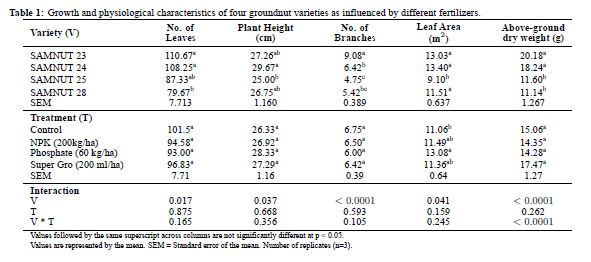
Groundnut (Arachis hypogaea L.) is a vital oilseed and protein crop in sub-Saharan Africa. As a legume, groundnut can fix atmospheric nitrogen into its root nodules. However, fertilizer application is still necessary when other essential nutrients needed for improving the quality and productivity of the seeds are limited in the soil. This study therefore investigated the effects of organic (Super GRO at 200 ml/ha) and inorganic fertilizers (NPK 15:15:15 at 200 kg/ha, single superphosphate (SSP) at 60 kg/ha) on the growth, yield, and seed quality of four groundnut varieties (SAMNUT 23, SAMNUT 24, SAMNUT 25, and SAMNUT 28). Data collected were subjected to two-way analysis of variance to test significant differences among the varieties and fertilizer treatments at p<0.05. The inorganic fertilizers (NPK and SSP) had a marked influence on both pod and seed yield when compared to the organic fertiliser (Super GRO), where the latter promoted higher vegetative growth. Varietal differences indicated that pod and seed yield were significantly highest in SAMNUT 24 and lowest in SAMNUT 23. Regardless of variety and fertiliser, the percentage moisture, ash, fibre, protein, fat, and carbohydrate ranged from 9.60-9.91%, 1.22-1.19%, 2.20-2.10%, 18.63-19.47%, 39.67-40.58%, and 27.20-28.38%, respectively. SAMNUT 24 had the highest protein content in its seeds, while SAMNUTS 28 and 23 had the highest fat and energy values when they were compared to other varieties. The organic Super Gro promoted higher carbohydrate accumulation with limited protein, fat, and fibre and energy values when compared to inorganic fertilisers. The foregoing results indicated that SAMNUT 24 and SAMNUT 25 responded positively to fertiliser application, most importantly, the inorganic fertilisers. The cultivation of these varieties under inorganic fertilisers should be encouraged where there is low soil fertility.
Full text article
References
AOAC. (2005). Official method of analysis (18th ed.). AOAC International. https://www.aoac.org/scientific-solutions/standards-and-official-methods/
Chaudhary, I. J., Neeraj, A., Siddiqui, M. A., & Singh, V. (2020). Nutrient management technologies and the role of organic matrix-based slow-release biofertilizers for agricultural sustainability: A review. Agricultural Reviews, 41, 1–13. https://doi.org/10.18805/ag.R-1958
Gulluoglu, L., Bakal, H., Onat, B., El Sabagh, A., & Arıoğlu, H. (2016). Characterization of peanut (Arachis hypogaea L.) seed oil and fatty acids composition under different growing seasons under Mediterranean environment. Journal of Experimental Biology and Agricultural Sciences, 4(5S), 564-571. https://doi.org/10.18006/2016.4(5S).564.571
Ibrahim, M. M. (2016). Optimization of biological nitrogen fixation and yield of groundnut (Arachis hypogaea L.) in a savanna Alfisol through fertilizer application and soil amendment (MSc thesis). University of Ibadan / N2Africa Project. Retrieved from https://www.n2africa.org/sites/default/files/MSc%20thesis%20Muhammed%20Mustapha%20Ibrahim.pdf
Ibrahim, A. M., Sanusi, J., & Usman, A. (2021). Growth and yield of groundnut (Arachis hypogaea L.) as affected by intra-row spacing and irrigation interval in Sudan Savannah Zone of Nigeria. International Journal of Agricultural Policy and Research, 9 (6), 153-159. https://doi.org/10.15739/IJAPR.21.017
Kayode, G. O. (2009). Potassium requirement of groundnut (Arachis hypogaea) in the lowland tropics. The Journal of Agricultural Science, 108(3), 643-647. https://doi.org/10.1017/S0021859600080072
Litterick, A., Harrier, L., Wallace, P., Watson, C. A., & Wood, M. (2003). Effects of composting manures and other organic wastes on soil processes and pest and disease interactions. Soil Association / Scottish Agricultural College. Retrieved from https://orgprints.org/6694/2/Annex_Effects_on_soils_and_crops.pdf
Melesse, M. B., Miriti, P., Muricho, G., Ojiewo, C. O., & Afari-Sefa, V. (2023). Adoption and impact of improved groundnut varieties on household food security in Nigeria. Journal of Agriculture and Food Research, 14, 100817. https://doi.org/10.1016/j.jafr.2023.100817
Musa, A. K., Kalejaiye, D. M., Ismaila, L. E., & Oyerinde, A. A. (2010). Proximate composition of selected groundnut varieties and their susceptibility to Trogoderma granarium Everts attack. Journal of Stored Products and Postharvest Research, 1, 13-17. https://academicjournals.org/journal/JSPPR/article-full-text-pdf/2D37C321111
Naab, J. B., Prasad, P. V. V., Boote, K. J., & Jones, J. W. (2009). Response of Peanut to Fungicide and Phosphorus in On-station and On-farm Tests in Ghana. Peanut Science, 36(2), 103-111. https://doi.org/10.3146/PS08-017.1
Obabire, S. O., Ayelari, P. O., & Agele, S. O. (2024). Manuring Effects on the Performance of Maize (Zea mays L.) and Groundnut (Arachis hypogaea L.) in a Relay Intercropping in Akure, Ondo State, Nigeria. International Journal of Bioorganic Chemistry, 9(1), 1–7. https://doi.org/10.11648/j.ijbc.20240901.11
Olayinka, B. U., & Etejere, E. O. (2013). Influence of weed management strategies on proximate composition of two varieties of groundnut (Arachis hypogaea L.). Annals Food Science and Technology, 14(2), 286-293. https://afst.valahia.ro/annals-food-science-and-technology-2013/
Olayinka, B. U., & Etejere, E. O. (2015). Growth analysis and yield of two varieties of groundnut (Arachis hypogaea L.) as influenced by different weed control methods. Indian Journal of Plant Physiology. 20, 130-136. https://doi.org/10.1007/s40502-015-0151-x
Olayinka, B. U., Abdulbaki, A. S., Alsamadany, H., Alzahrani, Y., Omorinoye, O. A., Olagunju, G. R., & Sulyman, A. (2023). Proximate composition, amino acid and fatty acid profiles of eight cultivars of groundnut grown in Nigeria. Legume Research-An International Journal, 46(1), 95-99. https://doi.org/10.18805/LRF-700
Olayinka, B. U., Lawal, A. R., Abdulkareem, K. A., Kareem, I., Babatunde, M. O., Ayinla, A., Sagaya, A., & Mustapha, O. T. (2025). Comparative evaluation of seed quality and physico-chemical properties of groundnut varieties consumed in Nigeria. AAU J. Physical & Applied Sciences, 5, 130-136. https://aaua.edu.ng/journals/
Patil, D. B., Pawar, P. P., Wadile, S. C., & Patil, H. M. (2017). Effect of integrated nutrient management on growth and yield of kharif groundnut (Arachis hypogaea L.). International Journal of Horticulture, Agriculture and Food Science, 1(1), 21-25. Retrieved from https://aipublications.com/uploads/issue_files/5%20IJHAF-MAY-2017-5.pdf
Reddy, S.T., Reddy, D.S., & Reddy, G.P. (2011). Fertilize management for maximizing productivity and profitability of export-oriented groundnut (Arachis hypogaea L.) Journal of Research ANGRAU, 39(4), 83-85. http://www.angrau.ac.in/media/7380/AGRI39-4.pdf
Suleiman, N. I. (2021). Testing varietal response to various fertilizers treatments: Phosphorus, Potassium and Micronutrients on improved groundnut variety (SAMNUT 24) in Ajingi and Gaya Savanna Zone of Nigeria. BIMA Journal of Science and Technology, 5(01), 21-30. https://journals.gjbeacademia.com/index.php/bimajst/
Ushasri, B., Krishna, T. G., Nagamadhuri, K. V., Ramu, Y. R., & Reddy, B. R. (2023). Effect of INM on nutrient concentration and their uptake under maize blackgram groundnut cropping sequence in Alfisols. International Journal of Plant & Soil Science, 35(19), 825-835. https://doi.org/10.9734/ijpss/2023/v35i193616
Yusuf, M., Abubakar, A., & Ibrahim, A. (2017). Comparative agronomic evaluation of SAMNUT groundnut varieties under varying nutrient regimes. Nigerian Agricultural Research Bulletin, 28(2), 56-66.
Zhang, G., Liu, Q., Zhang, Z., Ci, D., Zhang, J., Xu, Y., Guo, Q., Xu, M., & He, K. (2023). Effect of reducing nitrogen fertilization and adding organic fertilizer on net photosynthetic rate, root nodules and yield in peanut. Plants, 12(16), 2902. https://doi.org/10.3390/plants12162902
Authors
Copyright (c) 2026 Olayinka, B. U, Ogundare, G. O, Babatunde, M. O.1 , Muhammed, G. Y, Lawal, A. R, and Ayinla, A.

This work is licensed under a Creative Commons Attribution-NonCommercial-ShareAlike 4.0 International License.
Authors who publish with this journal agree to the following terms:
- Authors retain copyright and grant the journal right of first publication with the work simultaneously licensed under a Creative Commons Attribution License [CC BY-NC-SA 4.0] that allows others to share the work with an acknowledgment of the work's authorship and initial publication in this journal.
- Authors are able to enter into separate, additional contractual arrangements for the non-exclusive distribution of the journal's published version of the work, with an acknowledgment of its initial publication in this journal.
- Authors are permitted and encouraged to post their work online.