
DETECTION OF BITCOIN FRAUD USING VARIATIONAL AUTO ENCODER AND LIGHT GRADIENT BOOSTING MACHINE

Article Sidebar
-
Bitcoin fraud detection, Variational Autoencoder, Light Gradient Boosting Machine, Class imbalance, Cryptocurrency security
Abstract
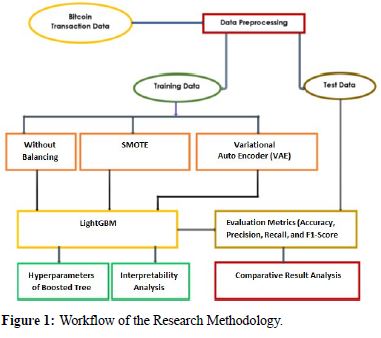
The proliferation of fraudulent behaviour in cryptocurrency ecosystems poses a significant threat to financial security infrastructure. This study develops an approach that uses Variational Autoencoders in combination with Light Gradient Boosting Machines for detecting fraudulent Bitcoin transactions. The Variational Autoencoder component encodes each transaction into a compact latent representation, which is concatenated with the original transaction features to enrich the representation available to the classifier. The Light Gradient Boosting Machine is responsible for classification. Experimental validation on the Elliptic dataset of bitcoin transactions shows the model achieves 99.2% accuracy and 96% F1 score for minority-class detection, outperforming other methods such as Random Forest (95.9% F1), ANN-based models (89.8% F1), and ensemble stacking (97% F1). These results far exceed those of previous approaches, demonstrating the model’s ability to enhance the security and integrity of cryptocurrency transactions.
Full text article
References
Aggarwal, C. C. (2015). Data mining: The textbook. Springer. DOI:https://doi.org/10.1007/978-3-319-14142-8
Al-Hashedi, K. G., Magalingam, P., Maarop, N., Samy, G. N., Rahim, F. B. A., Shanmugam, M., & Hasan, M. K. (2022). A supervised
model to detect suspicious activities in the bitcoin network. In International Conference on Emerging Technologies and Intelligent
Systems (pp. 606–615). Springer International Publishing. DOI:https://doi.org/10.1007/978-3-031-25274-7_53
Antonopoulos, A. M., & Harding, D. A. (2023). Mastering Bitcoin: Programming the open blockchain. O’Reilly Media, Inc.
Asiri, A., & Somasundaram, K. (2025). Graph convolution network for fraud detection in bitcoin transactions. Scientific Reports, 15(1), 11076. DOI:https://doi.org/10.1038/s41598-025-95672-w
Bazán-Palomino, W. (2023). The increased interest in Bitcoin and the immediate and long-term impact of Bitcoin volatility on global stock markets. Economic Analysis and Policy, 80, 1080–1095. DOI:https://doi.org/10.1016/j.eap.2023.08.016
Böhme, R., Christin, N., Edelman, B., & Moore, T. (2015). Bitcoin: Economics, technology, and governance. Journal of Economic Perspectives, 29(2), 213–238. DOI:https://doi.org/10.1257/jep.29.2.213
Bolton, R. J., & Hand, D. J. (2004). Statistical fraud detection: A review. Quality Control and Applied Statistics, 49(3), 313–314. DOI:https://doi.org/10.1214/ss/1042727940
Chen, B., Wei, F., & Gu, C. (2021). Bitcoin theft detection based on supervised machine learning algorithms. Security and Communication Networks. DOI:https://doi.org/10.1155/2021/6643763
Chen, W., Wu, J., Zheng, Z., Chen, C., & Zhou, Y. (2019). Market manipulation of Bitcoin: Evidence from mining the Mt. Gox transaction network. In Proceedings of IEEE INFOCOM 2019 (pp. 964–972). DOI:https://doi.org/10.1109/INFOCOM.2019.8737416
Cholevas, C., Angeli, E., Sereti, Z., Mavrikos, E., & Tsekouras, G. E. (2024). Anomaly detection in blockchain networks using
unsupervised learning: A survey. Algorithms, 17(5), 201. DOI:https://doi.org/10.3390/a17050201
Dai, Z., & Huang, W. (2025). Improving energy management practices through accurate building energy consumption prediction: analyzing the performance of LightGBM, RF, and XGBoost models with advanced optimization strategies. Electrical Engineering,
107(9), 12583–12605.
Ding, H., Sun, Y., Huang, N., Shen, Z., & Cui, X. (2023). TMG-GAN: Generative adversarial networks-based imbalanced learning for network intrusion detection. IEEE Transactions on Information Forensics and Security, 19, 1156–1167. DOI:https://doi.org/10.1109 TIFS.2023.3331240
Elliptic. (2019). Elliptic dataset. Kaggle. Retrieved from https://www.kaggle.com/datasets/ellipticco/elliptic-data-set
Elmougy, Y., & Liu, L. (2023). Demystifying fraudulent transactions and illicit nodes in the bitcoin network for financial forensics. In Proceedings of the 29th ACM SIGKDD Conference on Knowledge Discovery and Data Mining (pp. 3979–3990). DOI:https://doi.org/10.1145/3580305.3599803
Fan, J., Mao, Y., Zhang, S., & Tan, Y. (2026). Transformer-Aware Graph Convolutional Network for Anomalous Bitcoin Transaction
Detection. In 2026 IEEE International Conference on Power, Electronics and Green Energy (ICPEGE) (pp. 1675– 1679). IEEE.
Farrukh, H., Zafar, S., Rehman, Z. U., Shah, A. A., & Alshammry, N. (2025). Blockchain-Based Fraud Detection: A Comparative Systematic Literature Review of Federated Learning and Machine Learning Approaches. Electronics, 14(24), 4952. DOI:https://doi.org/10.3390/electronics14244952
Han, N., Zhang, R., Liu, X., & Zhang, H. (2026). Illicit Bitcoin transaction detection via feature-gated temporal graph learning.
Hasan, M., Rahman, M. S., Janicke, H., & Sarker, I. H. (2024). Detecting anomalies in blockchain transactions using machine learning classifiers. Blockchain: Research and Applications, 100207. DOI:https://doi.org/10.1016/j.bcra.2024.100207
Indira, M., Basha, R. M., Sivamma, P., Babu, M. S., & Ketan, S. H. N. (2026). Attention-Balanced Variational Autoencoder Framework for Credit Card Fraud Detection under Extreme Class Imbalance. In 2026 7th International Conference on Intelligent Communication
Technologies and Virtual Mobile Networks (ICICV) (pp. 1060–1067). IEEE.
Jordan, J. (2018.). Variational autoencoders. Retrieved from https://www.jeremyjordan.me/variational-autoencoders/
Latif, M. N., Kaplan, M., & Khan, A. U. I. (2025). Unsupervised machine learning based anomaly detection in high frequency data: Evidence from Cryptocurrency Market. Pakistan Journal of Commerce and Social Sciences, 19(3), 407–440.
Lin, Z., Luo, Q., Wu, D., Shen, J., Li, L., Nong, X., & Qin, Z. (2026). Detecting illicit transactions in bitcoin: a wavelet-temporal graph transformer approach for anti-money laundering. Scientific Reports, 16(1), 1548. DOI:https://doi.org/10.1038/s41598-026-01548-x
Mitchell, T. M. (1997). Machine learning. McGraw-Hill. Na, G., Park, M., Kim, S., Shin, J., & Chai, S. (2026). Knowledge-Integrated Representation Learning for Crypto Anomaly Detection under Extreme Label Scarcity; Relational Domain-Logic Integration with Retrieval-Grounded Context and Path-Level Explanations. arXiv preprint arXiv:2601.12839. DOI:https://doi.org/10.48550/arXiv.2601.12839
Pocher, N., Zichichi, M., Merizzi, F., Shafiq, M. Z., & Ferretti, S. (2023). Detecting anomalous cryptocurrency transactions: An AML/CFT application of machine learning-based forensics. Electronic Markets, 33(1), 37. DOI:https://doi.org/10.1007/s12525-023-00650-z
Nakamoto, S. (2008). Bitcoin: A peer-to-peer electronic cash system. Retrieved from https://bitcoin.org/bitcoin.pdf
Nerurkar, P. (2023). Illegal activity detection on Bitcoin transaction using deep learning. Soft Computing, 27(9), 5503–5520. DOI:https://doi.org/10.1007/s00500-022-07779-1
Nimmagadda, N., & Madiajagan, M. (2025). Graph Neural Networks for Illicit Transaction Detection in the Elliptic Bitcoin Dataset. In
2025 5th International Conference on Evolutionary Computing and Mobile Sustainable Networks (ICECMSN) (pp. 1121–1127).
IEEE. Pinheiro Cinelli, L., Araújo Marins, M., Barros da Silva, E. A., & Lima Netto, S. (2021). Variational autoencoder. In Variational methods for machine learning with applications to deep networks (pp. 111–149). Springer. DOI:https://doi.org/10.1007/978-3-
030-70604-6_6
Weber, M., Domeniconi, G., Chen, J., Weidele, D. K. I., Bellei, C., Robinson, T., & Leiserson, C. E. (2019). Anti-money laundering in Bitcoin: Experimenting with graph convolutional networks for financial forensics. arXiv preprint arXiv:1908.02591. DOI:https://doi.org/10.48550/arXiv.1908.02591
Authors
Copyright (c) 2026 Muhammad Nazeer Musa, Abdulkadir Nafisat, Adebajo Olamilekan Adewale, Ramat Abba Imam, and Samaila Musa Abdullahi

This work is licensed under a Creative Commons Attribution-NonCommercial-ShareAlike 4.0 International License.
Authors who publish with this journal agree to the following terms:
- Authors retain copyright and grant the journal right of first publication with the work simultaneously licensed under a Creative Commons Attribution License [CC BY-NC-SA 4.0] that allows others to share the work with an acknowledgment of the work's authorship and initial publication in this journal.
- Authors are able to enter into separate, additional contractual arrangements for the non-exclusive distribution of the journal's published version of the work, with an acknowledgment of its initial publication in this journal.
- Authors are permitted and encouraged to post their work online.