
AGRICULTURAL PRODUCTION IN PAPUA NEW GUINEA USING OPTIMIZATION AND STOCHASTIC MODELLING

Article Sidebar
-
Optimization, Stochastic Modelling, Agriculture, Linear Programming, Agricultural Planning
Abstract
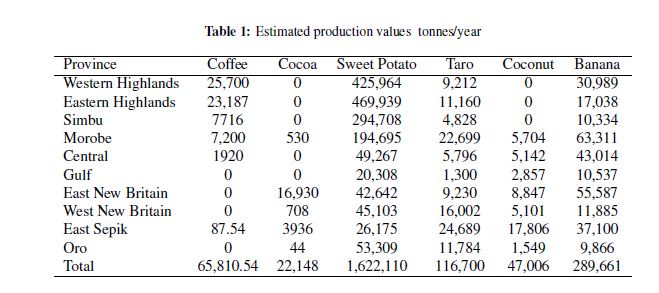
In Papua New Guinea, agriculture is one of the most important sectors, as it provides a livelihood of more than 80% of the rural population by contributing significantly to national income and food security. This paper applies optimization and stochastic modelling techniques to analyse agricultural production across selected provinces in PNG. A linear programming model is developed to determine the best way to allocate agricultural land among major crops such as coffee, cocoa, sweet potato, banana, taro, and coconut. A stochastic model is used to represent how crop yields can change due to uncertain factors such as weather, pests, or climate conditions by simulating these variations and assess production risk. Agricultural data were obtained from Food and Agriculture Organization Corporate Statistical Database (FAOSTAT), national agriculture reports and other published sources. The results demonstrate that using optimization to decide how land is allocated to crops can significantly improve agricultural productivity compared to traditional farming methods. The stochastic model highlights the importance of risk-aware decision-making, mainly under unpredictable climate conditions. The study concludes that combining optimization and stochastic modelling provides useful framework for improving agriculture planning and decision making. The findings may assist policy makers, agricultural planners and rural development agencies to promote sustainable agriculture production and efficient resources allocation.
Full text article
References
Bhamare, M. A. (2023). Optimizing crop selection and production planning in agriculture: Applications of linear programming
for profit maximization and sustainability. International Journal of Research Publication and Reviews, 4(6):3281–3287. DOI:
10.55248/gengpi.4.623.46630.
Bhatia, M. and Rana, A. (2020). A mathematical approach to optimize crop allocation – a linear programming model. International
Journal of Design and Nature and Ecodynamics, 15(2):245–252. DOI: 10.18280/ijdne.150215.
FAOSTAT (2023). Agricultural production statistics: Papua New Guinea. Available at: https://www.fao.org/faostat.
Filippi, C., Mansini, R., and Stevanato, E. (2017). Mixed integer linear programming models for optimal crop selection. Computers
and Operations Research, 81:26–39. DOI: 10.1016/j.cor.2016.12.004.
Food and Agriculture Organization (2024). Papua New Guinea agricultural profile.
Fytilis, K. and Semos, A. (2022). Crop management by linear programming: A literature review. International Journal of Innovation
Scientific Research and Review, 4(2):2364–2366. DOI: 10.6084/m9.figshare.20466030.
Kan, X., Thayer, T. C., Carpin, S., and Karydis, K. (2021). Task planning on stochastic aisle graphs for precision agriculture. arXiv
preprint arXiv:2102.01825. DOI: 10.48550/arXiv.2102.01825.
Mitu, A. A. and Hasan, M. B. (2024). Application of stochastic programming in agricultural and newsvendor problems and its application
in real life. Dhaka University Journal of Science, 72(1):45–58.
Reis, S. A. d., Leal, J. E., and Thom´e, A. M. T. (2023). A two-stage stochastic linear programming model for tactical planning in the
soybean supply chain. Logistics, 7(3):49. DOI: 10.3390/logistics7030049.
Sehgal, G., Gupta, B., Paneri, K., Singh, K., Sharma, G., and Shroff, G. (2017). Crop planning using stochastic visual optimization. In
2017 IEEE Visualization in Data Science (VDS), pages 47–51. DOI: 10.1109/VDS.2017.8573443.
Vlassak, V. and Bourke, M. (2004). Estimates of Food Crop Production in Papua New Guinea. Australian National University.
World Bank (2014). Coffee and cocoa agriculture project Papua New Guinea.
9
Authors
Copyright (c) 2026 Jordan Duma, Cyril Sarsorou, John Lanta, Mohsen Aghaeiboorkheili

This work is licensed under a Creative Commons Attribution-NonCommercial-ShareAlike 4.0 International License.
Authors who publish with this journal agree to the following terms:
- Authors retain copyright and grant the journal right of first publication with the work simultaneously licensed under a Creative Commons Attribution License [CC BY-NC-SA 4.0] that allows others to share the work with an acknowledgment of the work's authorship and initial publication in this journal.
- Authors are able to enter into separate, additional contractual arrangements for the non-exclusive distribution of the journal's published version of the work, with an acknowledgment of its initial publication in this journal.
- Authors are permitted and encouraged to post their work online.