
EFFICIENCY OF ELECTROKINETIC REMEDIATION IN REDUCING CADMIUM TOXICITY AND RESTORING ANTIOXIDANT PROTECTION AND PHYSIOLOGICAL DEVELOPMENT IN Triticum aestivum L.

Article Sidebar
-
Antioxidant enzymes, Electrokinetic remediation, Cadmium toxicity, oxidative stress
Abstract
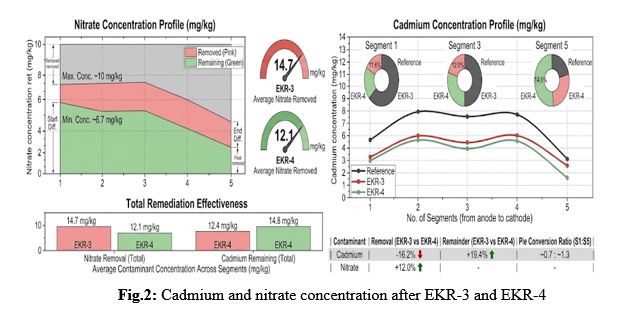
This study investigated the effects of electrokinetic remediation on the growth and physiological welfare of wheat (Triticum aestivum L., variety "Neelum") following soil contamination with Cadmium nitrate at 60 and 120 mg kg⁻¹ soil. The non-remediated control was used to assess two different DC voltages (7V and 14V). A 3 × 3 factorial completely randomized design (CRD) with three replications was used. The result of this study demonstrated that Cadmium pollution significantly delayed plant growth, leading to an apparent decay in fresh weight, dry biomass, and root length. The three antioxidant enzyme activities, such as Superoxide Dismutase, Peroxidase, and Catalase, indicate severe oxidative stress with an abrupt increase in response to high Cadmium concentrations, while photosynthetic pigments (Chlorophyll a, b, and carotenoids) declined. Cd2+ and NO-3 ions migrated more easily when EKR was applied through electromigration and electroosmotic flow; the 14 V treatment (EKR-4) was more effective at mobilizing pollutants than the 7V treatment (EKR-3). Root length decreased by 42% at 120 mg Cd compared to control, while fresh and dry weights showed reductions of 38% and 45%, respectively. The biomass and pigment levels of wheat plants recovered significantly (P < 0.001) after remediation. Additionally, plants growing in remediated soil showed a significant drop-in antioxidant enzyme activity (SOD decreased by 58%, POD by 47%, and CAT by 52% at 14V compared to the non-remediated control), suggesting that the bioavailable toxic burden had been successfully reduced. These results imply that 14 V electrokinetic therapy is a successful method for recovering clayey loam soils contaminated with heavy metals, reducing phytotoxicity, and reestablishing crop growth under the specific experimental conditions of this study.
Full text article
References
Abozaid, K. J., & Fattah, Y. M. (2024). Molecular analysis of olive (Olea europaea L.) in Iraq using the internal transcribed spacer (ITS) region. Biocatalysis and Agricultural Biotechnology, 59, 103251. 10.1016/j.bcab.2024.103251
Abuzaid, K. J., & Fattah, Y. M. (2024). Genetic diversity of olive varieties in northern Iraq using microsatellite markers. Egyptian Journal of Botany, 64(1), 419-429. doi. 10.21608/ejbo.2023.230750.2456
Acar, Y. B., & Alshawabkeh, A. N. (1993). Principles of electrokinetic remediation. Environmental science & technology, 27(13), 2638-2647.
Ankush, Ritambhara, Lamba, S., Deepika, & Prakash, R. (2024). Cadmium in environment—an overview. Cadmium Toxicity in Water: Challenges and Solutions, 3-20. https://doi.org/10.1007/978-3-031-54005-9_1
Aebi, H. (1984). Catalase in vitro. Methods in Enzymology, 105, 121-126. 10.1016/S0076-6879(84)05016-
Araújo, A. P. (2003). Analysis of variance of primary data on plant growth analysis. Pesquisa Agropecuária Brasileira, 38(1), 1-10. https://doi.org/10.1590/S0100-204X2003000100001
Arif, N., Yadav, V., Singh, S., Kushwaha, B. K., Singh, S., Tripathi, D. K., Vishwakarma, K., Sharma, S., Dubey, N., & Chauhan, D. (2016). Assessment of antioxidant potential of plants in response to heavy metals. In Plant responses to xenobiotics (pp. 97-125). Springer. DOIhttps://doi.org/10.1007/978-981-10-2860-1_5
Bouida, L., Rafatullah, M., Kerrouche, A., Qutob, M., Alosaimi, A. M., Alorfi, H. S., & Hussein, M. A. (2022). A review on cadmium and Cadmium contamination: Sources, fate, mechanism, health effects and remediation methods. Water, 14(21), 3432. https://doi.org/10.3390/w14213432
Chance, B., & Maehly, A. (1955). [136] Assay of catalases and peroxidases. https://doi.org/10.1016/S0076-6879(55)02300-8
Giannopolitis, C. N., & Ries, S. K. (1977). Superoxide dismutases: I. Occurrence in higher plants. Plant physiology, 59(2), 309-314. https://doi.org/10.1104/pp.59.2.309
Gee, G. W., & Bauder, J. W. (1986). Particle‐size analysis. Methods of soil analysis: Part 1 Physical and mineralogical methods, 5, 383-411. https://doi.org/10.2136/sssabookser5.1.2ed.c15
Gill, S. S., & Tuteja, N. (2010). Reactive oxygen species and antioxidant machinery in abiotic stress tolerance in crop plants. Plant physiology and biochemistry, 48(12), 909-930. https://doi.org/10.1104/pp.59.2.309
Lichtenthaler, H. K. (1987). Chlorophylls and carotenoids: pigments of photosynthetic biomembranes. Methods in Enzymology, 148, 350-382. 10.1016/0076-6879(87)48036-1
Lux, A., Martinka, M., Vaculík, M., & White, P. J. (2011). Root responses to cadmium in the rhizosphere: a review. Journal of Experimental Botany, 62(1), 21-37. https://doi.org/10.1093/jxb/erq281
Parmar, P., Kumari, N., & Sharma, V. (2013). Structural and functional alterations in photosynthetic apparatus of plants under cadmium stress. Botanical Studies, 54(1), 45.
https://doi.org/10.1186/1999-3110-54-45
Rani, M., Vikas, Kumar, R., Lathwal, M., & Kamboj, A. (2024). Effect and responses of Cadmium toxicity in plants. In Cadmium toxicity mitigation: sustainable Nexus approaches (pp. 211-241). Springer. https://doi.org/10.1007/978-3-031-46146-0_10
Rizwan, M., Ali, S., Adrees, M., et al. (2017). A critical review on effects, tolerance mechanisms and management of cadmium in vegetables. Chemosphere, 182, 90-105. 10.1016/j.chemosphere.2017.05.013
Xu, H., Zhao, P., Ran, Q., Li, W., Wang, P., Luo, Y., ... & Zhang, R. (2021). Enhanced electrokinetic remediation for Cd-contaminated clay soil by addition of nitric acid, acetic acid, and EDTA: Effects on soil micro-ecology. Science of The Total Environment, 772, 145029. 10.1016/j.scitotenv.2021.145029
Verma, S., Bhatt, P., Verma, A., Mudila, H., Prasher, P., & Rene, E. R. (2023). Microbial technologies for heavy metal remediation: effect of process conditions and current practices: S. Verma et al. Clean Technologies and Environmental Policy, 25(5), 1485-1507. https://doi.org/10.1007/s10098-021-02029-8
Virkutyte, J., Sillanpää, M., & Latostenmaa, P. (2002). Electrokinetic soil remediation—critical overview. Science of the total environment, 289(1-3), 97-121. https://doi.org/10.1016/S0048-9697(01)01027-0
Voglar, D., & Lestan, D. (2014). Chelant soil-washing technology for metal-contaminated soil. Environmental technology, 35(11), 1389-1400. https://doi.org/10.1080/09593330.2013.869265
Wen, D., Fu, R., & Li, Q. (2021). Removal of inorganic contaminants in soil by electrokinetic remediation technologies: A review. Journal of hazardous materials, 401, 123345. DOI: 10.1016/j.jhazmat.2020.123345
Authors
Copyright (c) 2026 EFFICIENCY OF ELECTROKINETIC REMEDIATION IN REDUCING CADMIUM TOXICITY AND RESTORING ANTIOXIDANT PROTECTION AND PHYSIOLOGICAL DEVELOPMENT IN Triticum aestivum L.

This work is licensed under a Creative Commons Attribution-NonCommercial-ShareAlike 4.0 International License.
Authors who publish with this journal agree to the following terms:
- Authors retain copyright and grant the journal right of first publication with the work simultaneously licensed under a Creative Commons Attribution License [CC BY-NC-SA 4.0] that allows others to share the work with an acknowledgment of the work's authorship and initial publication in this journal.
- Authors are able to enter into separate, additional contractual arrangements for the non-exclusive distribution of the journal's published version of the work, with an acknowledgment of its initial publication in this journal.
- Authors are permitted and encouraged to post their work online.