
INFLUENCE OF FOLIAR APPLICATION OF ZINC SULFATE AND 6-BENZYLADENINE ON THE CHEMICAL PROPERTIES OF ZINNIA CULTIVARS (Zinnia elegans)

Article Sidebar
-
Zinnia elegans, essential micronutrients, benzyl adenine (BA) levels, foliar spraying
Abstract
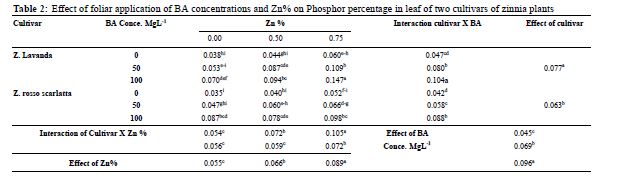
This study was conducted in the lath house of the Horticulture Department Nursery, College of Agricultural Engineering Sciences, University of Duhok, Kurdistan Region, Iraq, during 2024 to investigate the effects of different zinc sulfate at levels (0, 0.50, and 0.75% Zn) and 6-Benzyladenine concentrations (0, 50, and 100 mg L⁻¹ BA) on some chemical properties and pigments of leaves part two Zinnia cultivars, ‘Lavanda’ and ‘Rosso Scarlatta’ only anthocyanin determine in the petals of flower part. The results showed that ‘Lavanda’ recorded significantly higher values of N, P, K, and Zn contents, reaching (3.65, 0.077, 3.707, and 0.063) %, respectively, compared with ‘Rosso Scarlatta’. Lavanda cultivar also showed significantly higher photosynthetic pigments and carbohydrate content, recording 22.287 mg g⁻¹, 12.435 mg g⁻¹, and 5.964%, respectively. Regarding BA concentration, spraying with 100 mg L⁻¹ resulted in the highest values of N, P, K, Zn, anthocyanin, photosynthetic pigments, and carbohydrate, reaching 3.95%, 0.096%, 4.130%, 0.077%, 205.372, 27.422 mg g⁻¹, 12.726 mg g⁻¹, and 5.753%, respectively. Similarly, spraying with Zn at 75% produced the highest values, reaching 3.78%, 0.089%, 3.951%, 0.071%, 192.925, 25.421 mg g⁻¹, 13.453 mg g⁻¹, and 5.913%, respectively. The triple interaction showed that ‘Lavanda’ treated with BA at 100 mg L⁻¹ and Zn at 75% produced significantly superior results for all measured parameters except anthocyanin. The highest anthocyanin content was recorded in ‘Rosso Scarlatta’ under BA100 mg L⁻¹ and Zn at 100%, reaching 236.233, compared with the lowest value of 116.250 in ‘Lavanda’ without BA and Zn application.
Full text article
References
Reference
Abdel-Wahia M.K.S., 1995. Physiological studies on Polianthus tuberosa L. and Strelitzia reginae Ait. plants. M. Sc. Thesis, Fac. Agric. , Cairo University.
Mohamed, T.M. Noor El-Deen and H.I. Mohamed, 2020. Effect of benzyladenine and chemical fertilization on growth, flowering, and chemical composition of Jasminum sambac plant. Sci. J. Flowers Ornamental Plants, 7(4): 379-391. DOI: 10.21608/sjfop.2020.122221
Abou-Dahab, T.A.M., 1992. Effect of growing media and chemical fertilization on the growth and chemical composition of Chlorophytum comosum Thunb and Asparagus sprengeri L. plants. M. Sc. Thesis, Fac. Agric., Cairo Univ.,
Anwar, S., Khalilzadeh, R., Khan, S., Bashir, R., Pirzad, A. and Malik, A., 2021. Mitigation of drought stress and yield improvement in wheat by zinc foliar spray relates to enhanced water use efficiency and zinc contents. International Journal of Plant Production, 15(3), pp.377-389.
Baloch, Q.B., Chachar, Q.I. and Tareen, M.N., 2008. Effect of foliar application of macro and micro nutrients on production of green chilies (Capsicum annuum L.). Journal of Agricultural Technology, 4(2), pp.177-184.
Bernal, M., Cases, R., Picorel, R. and Yruela, I., 2007. Foliar and root Cu supply affects differently Fe -and Zn-uptake and photosynthetic activity in soybean plants. Environmental and experimental botany, 60(2), pp.145-150.
Brady N. C. and Ray, R. W., 2000. Elements of the Nature and Properties of Soil. Upper saddle Rover, New Jersy: Prentice-Hill Inc, pp.126-132.
Brickell, C., 1997. The American Horticultural Society A-Z Encyclopedia of Garden Plants. DK Publishing, Inc., New York, USA, 1092 p.
Broadley, M.R., White, P.J., Hammond, J.P., Zelko, I. and Lux, A., 2007. Zinc in plants. New phytologist, 173(4), pp.677-702.
Cakmak I., 2002. Plant nutrition research: Priorities to meet human needs for food in sustainable ways. Plant and Soil 247: 3–24.
Cakmak, I., Marschner, H. and Bangerth, F., 1989. Effect of zinc nutritional status on growth, protein metabolism and levels of indole-3-acetic acid and other phytohormones in bean (Phaseolus vulgaris L.). Journal of Experimental Botany, 40(3), pp.405-412.
Chung, B.N. and Lee, S.W., 1998. Effects of plant growth regulators, nitrogen and sucrose on anthocyanin formation by callus culture of Euphorbia milii var. splendens. RDA Journal of Horticulture Science (Korea Republic), 40(1).
Colasanti, J., Tremblay, R., Wong, A.Y., Coneva, V., Kozaki, A. and Mable, B.K., 2006. The maize Indeterminate1 flowering time regulator defines a highly conserved zinc finger protein family in higher plants. Bmc Genomics, 7(1), p.158.
Deikman, J. and Hammer, P.E., 1995. Induction of anthocyanin accumulation by cytokinins in Arabidopsis thaliana. Plant physiology, 108(1), pp.47-57.
Dole, H.C., 1999. Zinnias: Colorful, butterfly approved. Butterfly Gardeners Quarterly. BGQ, PO Box, 30931, seattle, WA. 98103.
El-Fouly, A.S.A., 1994. Physiological studies on Peperomia obtusifolia, L. and Scindapsus aureus, Schotf plants. M. Sc. Thesis, Fac. of Agric., Cairo Univ.
El-Naggar, A.M., Mahmoud, S.A. and Tayel, S.I., 2009. Bioaccumulation of some heavy metals and histopathological alterations in liver of Oreochromis niloticus in relation to water quality at different localities along the River Nile, Egypt. World Journal of Fish and Marine Sciences, 1(2), pp.105-114.
El-Sayed, B.A., 1994. Effect of media and nutrition on some ornamental plants. M. Sc. Thesis, Fac. of Agric., Cairo Univ
Eraki, M.A., 1994. Effect of benzyladenine (BA) application on the growth, fruit yield and some chemical constituents of Hibiscus sabdariffa L. plants. Minofiya J. Agric. Res, 2, pp.623-637.
Gomaa, A.A.R., Samy, M.N., Desoukey, S.Y. and Kamel, M., 2019. A comprehensive review of phytoconstituents and biological activities of genus Zinnia. Journal of Advanced Biomedical and Pharmaceutical Sciences, 2(1), pp.29-37.
Kaya, M.U.H.A.R.R.E.M., 2005. Effect of pre-sowing seed treatment with zinc and foliar spray of humic acid on yield of common bean (Phaseolus vulgaris L.). Int. J. Agric. Biol. 6(7): 875–878.
Khosa, S.S., Adnan Younis, A.Y., Adnan Rayit, A.R., Shahina Yasmeen, S.Y. and Atif Riaz, A.R., 2011. Effect of foliar application of macro and micro nutrients on growth and flowering of Gerbera jamesonii L. Amer. Euras. J Agric. Environ. Sci. 2011;11:736-757.
Kolomazník, K., Pecha, J., Friebrová, V., Janáčová, D. and Vašek, V., 2012. Diffusion of biostimulators into plant tissues. Heat and mass transfer, 48(9), pp.1505-1512.
Krug, B.A., 2004. The chemical growth regulation of bulb crops using flurprimidol as foliar sprays, substrate drenches, and pre-plant bulb soaks. MSc. thesis, North Caroline State Univ, Raleigh, USA.
Lalit Bhatt, L.B. and Srivastava, B.K., 2005. Effect of foliar application of micronutrients on nutrient uptake in tomato. Vegetable Science 32 (2): 158-161.
Latimer, J.G., 1991. Growth retardants affect landscape performance of zinnia, impatiens, and marigold. HortScience, 26(5), pp.557-560.
Liew, C.S., 1988. Foliar fertilizers from Uniroyal [Chemical Company, Singapore] and their potential in Pakistan. Proceedings of seminar on micro-nutrients in soils and crops in Pak. 277. (Abstract).
Malvi, U.R., 2011. Interaction of micronutrients with major nutrients with special reference to potassium. Karnataka Journal of Agricultural Sciences, 24(1):106–109.
Massoud, A.M., Abou-Zied, M.Y. and Bakry, M.A., 2005. Response of pea plants grown in clay soil to micronutrients and Rhizobium-inoculation. Egypt J Appl Sci, 20, pp. 329-346.
Mazrou, M.M., Afify, M.M., El-Kholy, S.A. and Morsy, G.A., 1994. Physiological studies on Ocimum basilicum L. plant. 1.-influence of kinetin application on the growth and essentianl oil content. Menofiya Journal of Agricultural Research (Egypt), 19(1part2), 421-434.
Mazrouh, M.M., 1992. The growth and tropane alkaloids distribution in the different organs of Datura innoxia Mill. plants in relation to benzyladenine (BA) application. Menofiya Journal of Agricultural Research, 17, : 1971-1983.
Menesi, F.A., Khalafalla, M.M. and Kandeel, Y., 1994. Effect of some growth regulators and calcium chloride on. Tagets erecta, .- Zinnia elegans, J. and Celosia argentea L. plants. The I st Conf. Omamental Hor. Fac. Agric. Rafr El-Sheikh, Tanta Univ., Egypt, 2: 408-425.
Młodzińska, E., 2009. Survey of plant pigments: molecular and environmental determinants of plant colors. Acta Biologica Cracovienca Series Botanica, 51(1), pp.7-16.
Pavlů, J., Novák, J., Koukalová, V., Luklová, M., Brzobohatý, B. and Černý, M., 2018. Cytokinin at the crossroads of abiotic stress signalling pathways. International Journal of Molecular Sciences, 19(8), p.2450.
Pobudkiewicz, A., 2008. The influence of growth retardants and cytokinins on flowering of ornamental plants. Acta Agrobotanica, 61(1): 137 141
Raifa, A.H., Hemmat, K.I.K., Hala, M.S.E. and Mervat, S.S., 2005. Increasing the active constituents of sepals of roselle (Hibiscus sabdariffa L.) plant by applying gibberellic acid and benzyladenine. Journal of Applied Sciences Research, 1(2), pp.137-146.
Sarwar, M., Jilani, G., Rafique, E., Akhtar, M.E. and Chaudhry, A.N., 2012. Impact of integrated nutrient management on yield and nutrient uptake by maize under rain-fed conditions. Pakistan Journal of Nutrition, 11(1), pp.27-33.
Sharma, J.R., Gupta, R.B. and Panwar, R.D., 2004. Growth, flowering and corm production of gladiolus cv. Friendship as influenced by foliar application of nutrients and growth regulators. Journal of ornamental horticulture, 7(3and4), pp.154-158.
Singh, A.K., Hembrom, R., Singh, J., Sisodia, A. and Pal, A.K., 2015. Effect of iron and zinc on growth and postharvest life in Lilium cv. Tresor. Environment and Ecology, 33(2), pp.625-8.
Takatsuji, H., Mori, M., Benfey, P.N., Ren, L. and Chua, N.H., 1992. Characterization of a zinc finger DNA‐binding protein expressed specifically in Petunia petals and seedlings. The EMBO Journal, 11(1), pp.241-249.
Talaat, I.M. and Youssef, A.A., 1998. Response of roselle plants (Hibiscus sabdariffa L.) to some growth regulating substances. Egypt, J. Physiol. sci., 22: 327-338.
Trivedi, A.P. and Dhumal, K.N., 2013. Effect of soil and foliar applications of zinc and iron on the yield and quality of onion (Allium cepa L.). Bangladesh Journal of Agricultural Research, 38(1), pp.41-48.
Authors
Copyright (c) 2026 Ban Jibrael Khoshaba, Niroosh Sulaiman Hasan , Ali Mohammed Jawad, Arzu Çığ,and Layla Shaaban Mohammed

This work is licensed under a Creative Commons Attribution-NonCommercial-ShareAlike 4.0 International License.
Authors who publish with this journal agree to the following terms:
- Authors retain copyright and grant the journal right of first publication with the work simultaneously licensed under a Creative Commons Attribution License [CC BY-NC-SA 4.0] that allows others to share the work with an acknowledgment of the work's authorship and initial publication in this journal.
- Authors are able to enter into separate, additional contractual arrangements for the non-exclusive distribution of the journal's published version of the work, with an acknowledgment of its initial publication in this journal.
- Authors are permitted and encouraged to post their work online.