
SOFTWARE DEVELOPMENT COST PREDICTION USING ENSEMBLE LEARNING TECHNIQUES

Article Sidebar
-
AdaBoost, Bagging, CatBoost, Ensemble Learning, Software Cost Estimation
Abstract
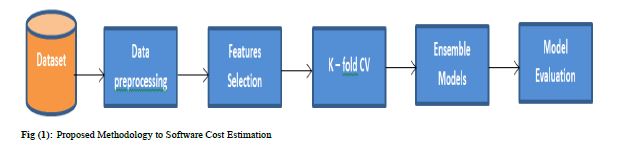
Cost estimation of software is an important task and should be done to complete the software project successfully. Traditional approaches of software cost estimation suffer from subjectivity and additional cost. To overcome these limitations with the traditional methods, the field of Machine learning has been incorporated as a promising method for the problem of software cost estimation. This paper explores using ensemble learning to improve cost predictions on two public benchmark datasets, Albrecht and Maxwell. Sequential Forward Feature Selection (SFS) is applied to pick the most relevant features and simplify models. Four ensemble methods ("Bagging", "AdaBoost", "XGBoost", and "CatBoost") have been implemented and evaluated on the benchmark Albrecht and Maxwell datasets. To avoid overfitting and to assess the model properly, the 10-fold cross-validation strategy was used. The results indicate that model performance is dependent on the dataset. CatBoost performed best on the Albrecht dataset, achieving the highest R² score of 0.943, while AdaBoost achieved the best performance on the Maxwell dataset, with an R² score of 0.735. These findings demonstrate the effectiveness of ensemble learning methods in improving the predictive accuracy of software cost estimation models.
Full text article
References
Airlangga, G. (2024). Integrating LightGBM and XGBoost for software defect classification problem. Jurnal Media Informatika Budidarma, 8(1), 430–440.
Aljohani, M., & Qureshi, R. (2017). Comparative Study of Software Estimation Techniques. International Journal of Software Engineering & Applications, 8(6), 39–53. https://doi.org/10.5121/ijsea.2017.8603
Dawson, C. W. (2026). A neural network approach to software project effort estimation. WIT Transactions on Information and Communication Technologies, 16.
Fadhil, A. A., Alsarraj, R. G. H., & Altaie, A. M. (2020). Software Cost Estimation Based on Dolphin Algorithm. IEEE Access, 8, 75279–75287. https://doi.org/10.1109/ACCESS.2020.2988867
Galar, M., Fernandez, A., Barrenechea, E., Bustince, H., & Herrera, F. (2011). A review on ensembles for the class imbalance problem: bagging-, boosting-, and hybrid-based approaches. IEEE Transactions on Systems, Man, and Cybernetics, Part C (Applications and Reviews), 42(4), 463–484.
Gorriz, J. M., Martin-Clemente, R., Segovia, F., Ramirez, J., Ortiz, A., & Suckling, J. (2026). Is K-fold cross validation the best model selection method for machine learning? Information Fusion, 135, 104404. https://doi.org/10.1016/j.inffus.2026.104404
Gupta, D., Pandey, M., Kumar, A., & Suganthan, P. N. (Eds.). (2026). Next-Generation Networks and Deployable Artificial Intelligence (Vol. 1794). Springer Nature Switzerland. https://doi.org/10.1007/978-3-032-15398-2
Hammad, M. (2023). Software cost estimation using stacked ensemble classifier and feature selection. International Journal of Advanced Computer Science and Applications, 14(6).
Hancock, J. T., & Khoshgoftaar, T. M. (2020). CatBoost for big data: an interdisciplinary review: JT Hancock, TM Khoshgoftaar. Journal of Big Data, 7(1), 94.
Ibrahim, A. A., Ridwan, R. L., Muhammed, M. M., Abdulaziz, R. O., & Saheed, G. A. (2020). Comparison of the CatBoost classifier with other machine learning methods. International Journal of Advanced Computer Science and Applications, 11(11), 738–748.
Li, S., & Zhang, X. (2020). Research on orthopedic auxiliary classification and prediction model based on XGBoost algorithm. Neural Computing and Applications, 32(7), 1971–1979.
Mahmood, Y., Kama, N., Azmi, A., Khan, A. S., & Ali, M. (2022). Software effort estimation accuracy prediction of machine learning techniques: A systematic performance evaluation. Software: Practice and Experience, 52(1), 39–65. https://doi.org/10.1002/spe.3009
Marcano-Cedeño, A., Quintanilla-Dom’inguez, J., Cortina-Januchs, M. G., & Andina, D. (2010). Feature selection using sequential forward selection and classification applying artificial metaplasticity neural network. IECON 2010-36th Annual Conference on IEEE Industrial Electronics Society, 2845–2850.
Martínez-Aguilar, S., Sánchez-García, Á. J., López-Martín, C., & Octavio Ocharán-Hernández, J. (2025). Systematic Literature Review on Effort Estimation by Software Development Life Cycle Phases. IEEE Access, 13, 153340–153358. https://doi.org/10.1109/ACCESS.2025.3605102
Meharunnisa, M. S., Abid, M., Awais, M., & Stevic, Z. (2023). Analysis of software effort estimation by machine learning techniques. Ing. Syst. Inf, 28(6), 1445–1457.
Mienye, I. D., & Sun, Y. (2022). A survey of ensemble learning: Concepts, algorithms, applications, and prospects. Ieee Access, 10, 99129–99149.
Ngo, G., Beard, R., & Chandra, R. (2022). Evolutionary bagging for ensemble learning. Neurocomputing, 510, 1–14.
Qassem, N. T., & Saleh, I. A. (2025). Prediction of Software Cost Estimation Using Stacking Ensemble Learning method. Procedia Computer Science, 258, 727–736.
Rahman, M., Roy, P. P., Ali, M., Gonc¸alves, T., & Sarwar, H. (2023). Software Effort Estimation using Machine Learning Technique. International Journal of Advanced Computer Science and Applications, 14(4). https://doi.org/10.14569/IJACSA.2023.0140491
Rai, P., Verma, D. K., & Kumar, S. (2021). A hybrid model for prediction of software effort based on team size. IET Software, 15(6), 365–375.
Saha, P., Patikar, S., & Neogy, S. (2020). A correlation-sequential forward selection based feature selection method for healthcare data analysis. 2020 IEEE International Conference on Computing, Power and Communication Technologies (GUCON), 69–72.
Sakhrawi, Z., Labidi, T., Sellami, A., & Bouassida, N. (2024). A stacking ensemble learning model for software development cost estimation. International Journal of Computer Information Systems and Industrial Management Applications, 16(3), 13.
Singh, S., & Kumar, K. (2023). Software Cost Estimation: A Literature Review and Current Trends. 2023 Third International Conference on Secure Cyber Computing and Communication (ICSCCC), 469–474. https://doi.org/10.1109/ICSCCC58608.2023.10176495
Suresh Kumar, P., Behera, H. S., Nayak, J., & Naik, B. (2022). A pragmatic ensemble learning approach for effective software effort estimation. Innovations in Systems and Software Engineering, 18(2), 283–299. https://doi.org/10.1007/s11334-020-00379-y
Tayyab, M. R., Usman, M., & Ahmad, W. (2016). A machine learning based model for software cost estimation. Proceedings of SAI Intelligent Systems Conference, 402–414.
Van Hai, V., Nhung, H. L. T. K., Prokopova, Z., Silhavy, R., & Silhavy, P. (2022). Toward Improving the Efficiency of Software Development Effort Estimation via Clustering Analysis. IEEE Access, 10, 83249–83264. https://doi.org/10.1109/ACCESS.2022.3185393
Wang, R. (2012). AdaBoost for feature selection, classification and its relation with SVM, a review. Physics Procedia, 25, 800–807.
Zhang, X., & Liu, C.-A. (2023). Model averaging prediction by K-fold cross-validation. Journal of Econometrics, 235(1), 280–301.
Authors
Copyright (c) 2026 Mazin Mohammed Ismael, Ibrahim Ahmed Saleh, Firas Abdularhman Yousif , and shamil Khadr Ramadhan

This work is licensed under a Creative Commons Attribution-NonCommercial-ShareAlike 4.0 International License.
Authors who publish with this journal agree to the following terms:
- Authors retain copyright and grant the journal right of first publication with the work simultaneously licensed under a Creative Commons Attribution License [CC BY-NC-SA 4.0] that allows others to share the work with an acknowledgment of the work's authorship and initial publication in this journal.
- Authors are able to enter into separate, additional contractual arrangements for the non-exclusive distribution of the journal's published version of the work, with an acknowledgment of its initial publication in this journal.
- Authors are permitted and encouraged to post their work online.