
THERAPEUTIC POTENTIAL OF <i>Clitoria ternatea</i> FLOWER NANOPARTICLES IN AMELIORATING DYSLIPIDEMIA, LIVER DYSFUNCTION, OXIDATIVE STRESS, AND SYSTEMIC INFLAMMATION IN RATS

Article Sidebar
-
Hyperlipidemia, anthocyanins, Clitoria ternatea, cholesterol
Abstract
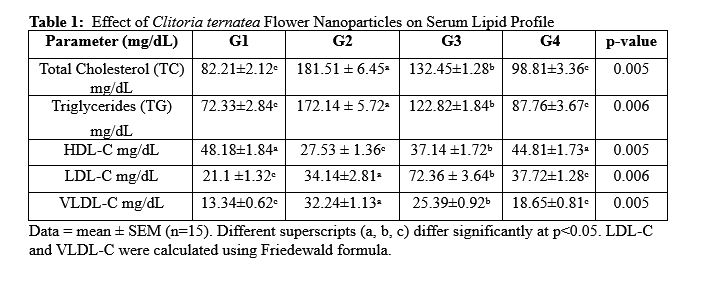
The present study was designed to investigate the therapeutic potential of Clitoria ternatea flower nanoparticles in ameliorating dyslipidemia, hepatic injury, oxidative stress, and inflammatory responses in high-fat diet-induced hyperlipidemic rats. Sixty male Wistar rats were randomly divided into four groups: normal control, high-fat diet control, and high-fat diet supplemented with C. ternatea nanoparticles at low (45 mg/kg) and high (90 mg/kg) doses administered orally for 60 days. Serum lipid profile, liver function biomarkers, oxidative stress indices, and inflammatory mediators were assessed using standard biochemical and ELISA techniques. High-fat diet feeding significantly elevated total cholesterol (181.51 mg/dL), triglycerides (172.14 mg/dL), LDL-C (34.14 mg/dL), and VLDL-C (32.24 mg/dL), while reducing HDL-C (27.53 mg/dL) compared to control values. Liver function markers including ALT (92.63 U/L), AST (172.65 U/L), ALP (227.34 U/L), and total bilirubin (1.27 mg/dL) were markedly increased in hyperlipidemic rats. Additionally, elevated malondialdehyde (6.82 nmol/mL) indicated enhanced lipid peroxidation, while antioxidant enzyme activities (SOD, CAT, GPx) were significantly reduced. Systemic inflammation was evidenced by increased TNF-α (46.23 pg/mL), IL-6 (39.42 pg/mL), IL-1β (27.46 pg/mL), and CRP (3.91 mg/L). Treatment with C. ternatea flower nanoparticles dose-dependently restored these alterations, with the high-dose group showing values approaching normal control levels. The nanoparticles improved lipid homeostasis, preserved hepatic integrity, reduced oxidative damage, and suppressed pro-inflammatory cytokine production. These findings demonstrate that C. ternatea flower nanoparticles exert potent antihyperlipidemic, hepatoprotective, antioxidant, and anti-inflammatory effects.
Full text article
References
Al-Salmi, F. A., Hamza, R. Z., & El-Shenawy, N. S. (2019). The interaction of zinc oxide/green tea extract complex nanoparticles and its effect on monosodium glutamate toxicity in liver of rats. Current Pharmaceutical Biotechnology, 20(6), 465-475: https://doi.org/10.2174/1389201020666190116115403.
Amezcua-Castillo, E., González-Pacheco, H., Sáenz-San Martín, A., Méndez-Ocampo, P., Gutierrez-Moctezuma, I., Massó, F., ... & Amezcua-Guerra, L. M. (2023). C-reactive protein: the quintessential marker of systemic inflammation in coronary artery disease—advancing toward precision medicine. Biomedicines, 11(9), 2444: https://doi.org/10.3390/biomedicines11092444.
Antonis, A. (1967). Automated techniques in serum lipid analysis. Journal of the American Oil Chemists' Society, 44(6), 333-340: https://doi.org/10.1007/BF02638643.
Arsova-Sarafinovska, Z., Eken, A., Matevska, N., Erdem, O., Sayal, A., Savaşer, A., ... & Aydin, A. (2009). Increased oxidative/nitrosative stress and decreased antioxidant enzyme activities in prostate cancer. Clinical Biochemistry, 42(12), 1228-1235: https://doi.org/10.1016/j.clinbiochem.2009.05.008.
Balderas, C., Angulo, J., Sevilleja-Ortiz, A., Peiró, C., Vallejo, S., Dongil, P., ... & Sánchez-Moreno, C. (2022). Onion and apple functional ingredients intake improves antioxidant and inflammatory status and vascular injury in obese Zucker rats. Antioxidants, 11(10), 1953: https://doi.org/10.3390/antiox11101953.
Balogh, D. B., Wagner, L. J., & Fekete, A. (2023). An overview of the cardioprotective effects of novel antidiabetic classes: focus on inflammation, oxidative stress, and fibrosis. International Journal of Molecular Sciences, 24(9), 7789: https://doi.org/10.3390/ijms24097789.
Burtis, C. A., & Bruns, D. E. (2014). Tietz Fundamentals of Clinical Chemistry and Molecular Diagnostics (7th ed.). Elsevier Health Sciences.
Chang, J. J., Hsu, M. J., Huang, H. P., Chung, D. J., Chang, Y. C., & Wang, C. J. (2013). Mulberry anthocyanins inhibit oleic acid-induced lipid accumulation by reduction of lipogenesis and promotion of hepatic lipid clearance. Journal of Agricultural and Food Chemistry, 61(25), 6069-6076: https://doi.org/10.1021/jf4006898.
Cheng, D., Zhang, M., Zheng, Y., Wang, M., Gao, Y., Wang, X., ... & Liu, J. (2024). α-Ketoglutarate prevents hyperlipidemia-induced fatty liver mitochondrial dysfunction and oxidative stress by activating the AMPK-PGC-1α/Nrf2 pathway. Redox Biology, 74, 103230: https://doi.org/10.1016/j.redox.2024.103230.
Damodaran, T., Cheah, P. S., Murugaiyah, V., & Hassan, Z. (2020). The nootropic and anticholinesterase activities of Clitoria ternatea Linn. root extract: Potential treatment for cognitive decline. Neurochemistry International, 139, 104785: https://doi.org/10.1016/j.neuint.2020.104785.
De Cól, J. P., de Lima, E. P., Pompeu, F. M., Cressoni Araújo, A., de Alvares Goulart, R., Bechara, M. D., ... & Barbalho, S. M. (2024). Underlying mechanisms behind the brain-gut-liver axis and metabolic-associated fatty liver disease (MAFLD): An update. International Journal of Molecular Sciences, 25(7), 3694: https://doi.org/10.3390/ijms25073694.
Dewanjee, S., Chakraborty, P., Mukherjee, B., & De Feo, V. (2020). Plant-based antidiabetic nanoformulations: The emerging paradigm for effective therapy. International Journal of Molecular Sciences, 21(6), 2217: https://doi.org/10.3390/ijms21062217.
Elswefy, S. E. S., Abdallah, F. R., Atteia, H. H., Wahba, A. S., & Hasan, R. A. (2016). Inflammation, oxidative stress and apoptosis cascade implications in bisphenol A-induced liver fibrosis in male rats. International Journal of Experimental Pathology, 97(5), 369-379: https://doi.org/10.1111/iep.12209.
Giang, T. T., Duc, C. K. T., Ha, P., Hone, N., Tram, D. T. N., Nguyen, N. Y., ... & Pham, D. T. (2025). Green-engineered PEI/PVA-functionalized silk fibroin nanoparticles for heat-stable delivery of Clitoria ternatea L. anthocyanins: Formulation, characterization, and sustainability assessment. ACS Omega, 10(34), 38703-38718: https://doi.org/10.1021/acsomega.5c06144
He, J., Zhang, P., Shen, L., Niu, L., Tan, Y., Chen, L., ... & Zhu, L. (2020). Short-chain fatty acids and their association with signalling pathways in inflammation, glucose and lipid metabolism. International Journal of Molecular Sciences, 21(17), 6356: https://doi.org/10.3390/ijms21176356.
Jamil, N., Zairi, M. N. M., Nasim, N. A. I. M., & Pa'ee, F. (2018). Influences of environmental conditions to phytoconstituents in Clitoria ternatea (Butterfly Pea Flower): A review. Journal of Science and Technology, 10(2), 208-228: https://doi.org/10.30880/jst.2018.10.02.029
Koushan, Y., Yari Khosroushahi, A., Geranmayeh, M. H., Hashemipour, S., Ghadimi Yari, M., & Khadem Haghighian, H. (2022). The effect of an aqueous extract of Illicium verum on serum levels of thyroid hormones and depression, anxiety, and stress in patients with hypothyroidism. Journal of Inflammatory Diseases, 26(3), 123-132: https://doi.org/10.32598/JID.26.3.1
Kresnapati, I. N. B. A., Kurniawan, S. Y., Novitarini, N., & Pratiwi, B. Y. H. (2025). Hepatoprotector edible flower in Indonesia: A review. Jurnal Pijar MIPA, 20(3), 544-553: https://doi.org/10.29303/jpm.v20i3.7145.
Maneesai, P., Iampanichakul, M., Chaihongsa, N., Poasakate, A., Potue, P., Rattanakanokchai, S., & Pakdeechote, P. (2021). Butterfly pea flower (Clitoria ternatea Linn.) extract ameliorates cardiovascular dysfunction and oxidative stress in nitric oxide-deficient hypertensive rats. Antioxidants, 10(4), 523: https://doi.org/10.3390/antiox10040523.
Masenga, S. K., Kabwe, L. S., Chakulya, M., & Kirabo, A. (2023). Mechanisms of oxidative stress in metabolic syndrome. International Journal of Molecular Sciences, 24(9), 7898: https://doi.org/10.3390/ijms24097898.
Memarzia, A., Khazdair, M. R., Behrouz, S., Gholamnezhad, Z., Jafarnezhad, M., Saadat, S., & Boskabady, M. H. (2021). Experimental and clinical reports on anti-inflammatory, antioxidant, and immunomodulatory effects of Curcuma longa and curcumin, an updated and comprehensive review. BioFactors, 47(3), 311-350: https://doi.org/10.1002/biof.1716.
Mobasher, M., Baioumy, S. A., Alazzouni, A. S., Khayyat, A. I. A., Awad, N. S., Abdelhakeem, M. A., & Al-Sowayan, N. S. (2023). Clitoria ternatea extract-loaded chitosan nanoparticles ameliorate diabetes and oxidative stress in diabetic rats. Indian Journal of Biochemistry and Biophysics, 60(7), 501-515. https://doi.org/10.56042/ijbb.v60i07.4140
Nair, V., Bang, W. Y., Schreckinger, E., Andarwulan, N., & Cisneros-Zevallos, L. (2015). Protective role of ternatin anthocyanins and quercetin glycosides from butterfly pea (Clitoria ternatea Leguminosae) blue flower petals against lipopolysaccharide (LPS)-induced inflammation in macrophage cells. Journal of Agricultural and Food Chemistry, 63(28), 6355-6365: https://doi.org/10.1021/acs.jafc.5b00928.
Nithianantham, K., Ping, K. Y., Latha, L. Y., Jothy, S. L., Darah, I., Chen, Y., ... & Sasidharan, S. (2013). Evaluation of hepatoprotective effect of methanolic extract of Clitoria ternatea (Linn.) flower against acetaminophen-induced liver damage. Asian Pacific Journal of Tropical Disease, 3(4), 314-319: https://doi.org/10.1016/S2222-1808(13)60073-3.
Ochoa-Acosta, A., Aispuro-Pérez, A., Cárdenas-Torres, F., Arias-Gastelum, M., Valdez-Flores, M. A., Espinoza, M. D. L. P., & Osuna-Martínez, U. (2026). Chemical characterization and protective effects of a subcritical water extract from olive pomace against dyslipidemia and hepatic steatosis in high-fat/high-sugar diet-fed mice. Molecules, 31(6), 995: https://doi.org/10.3390/molecules31060995
Oguis, G. K., Gilding, E. K., Jackson, M. A., & Craik, D. J. (2019). Butterfly pea (Clitoria ternatea), a cyclotide-bearing plant with applications in agriculture and medicine. Frontiers in Plant Science, 10, 645: https://doi.org/10.3389/fpls.2019.00645
Omodanisi, E. I., Aboua, Y. G., Chegou, N. N., & Oguntibeju, O. O. (2017). Hepatoprotective, antihyperlipidemic, and anti-inflammatory activity of Moringa oleifera in diabetic-induced damage in male Wistar rats. Pharmacognosy Research, 9(2), 182-187: https://doi.org/10.4103/pr.pr_108_16.
Pacinella, G., Ciaccio, A. M., & Tuttolomondo, A. (2022). Endothelial dysfunction and chronic inflammation: The cornerstones of vascular alterations in age-related diseases. International Journal of Molecular Sciences, 23(24), 15722: https://doi.org/10.3390/ijms232415722.
Pateiro, M., Gómez, B., Munekata, P. E. S., Barba, F. J., Putnik, P., Kovačević, D. B., & Lorenzo, J. M. (2021). Nanoencapsulation of promising bioactive compounds to improve their absorption, stability, functionality and the appearance of the final food products. Molecules, 26(6), 1547: https://doi.org/10.3390/molecules26061547.
Rao, M. J., Duan, M., Zhou, C., Jiao, J., Cheng, P., Yang, L., & Zheng, B. (2025). Antioxidant defense system in plants: Reactive oxygen species production, signaling, and scavenging during abiotic stress-induced oxidative damage. Horticulturae, 11(5), 477: https://doi.org/10.3390/horticulturae11050477.
Rasool, M., Iqbal, J., Malik, A., Ramzan, H. S., Qureshi, M. S., Asif, M., & Karim, S. (2014). Hepatoprotective effects of Silybum marianum (Silymarin) and Glycyrrhiza glabra (Glycyrrhizin) in combination: A possible synergy. Evidence-Based Complementary and Alternative Medicine, 2014, 641597: https://doi.org/10.1155/2014/641597.
Sasmana, I. G. A. P., Wihandani, D. M., Sadeva, I. G. K. A., Halim, W., Agustini, P. P., Samala, L., ... & Jaya, N. K. A. A. S. (2024). Antiobesity and antidyslipidemic properties of Clitoria ternatea petals aqueous extract against rats induced by high-fat diet. Turkish Journal of Medical Sciences, 54(2), 401-410: https://doi.org/10.55730/1300-0144.5775.
Shah, S., Chauhan, H., Madhu, H., Mori, D., Soniwala, M., Singh, S., & Prajapati, B. (2025). Lipids fortified nano phytopharmaceuticals: A breakthrough approach in delivering bio-actives for improved therapeutic efficacy. Pharmaceutical Nanotechnology, 13(1), 70-89: https://doi.org/10.2174/0118743453297939240729052243.
Ullah, A., Singla, R. K., Batool, Z., Cao, D., & Shen, B. (2024). Pro- and anti-inflammatory cytokines are the game-changers in childhood obesity-associated metabolic disorders (diabetes and non-alcoholic fatty liver diseases). Reviews in Endocrine and Metabolic Disorders, 25(4), 783-803: https://doi.org/10.1007/s11154-024-09921-9.
Wang, H., & Joseph, J. A. (1999). Quantifying cellular oxidative stress by dichlorofluorescein assay using microplate reader. Free Radical Biology and Medicine, 27(5-6), 612-616: https://doi.org/10.1016/S0891-5849(99)00107-0.
Wazir, M., Olanrewaju, O. A., Yahya, M., Kumari, J., Kumar, N., Singh, J., & Singh, J. (2023). Lipid disorders and cardiovascular risk: A comprehensive analysis of current perspectives. Cureus, 15(12), e50575: https://doi.org/10.7759/cureus.50575.
Wei, Y., Quan, L., Zhou, C., & Zhan, Q. (2018). Factors relating to the biodistribution and clearance of nanoparticles and their effects on in vivo application. Nanomedicine, 13(12), 1495-1512: https://doi.org/10.2217/nnm-2018-0046.
Widowati, W., Darsono, L., Natariza, M. R., Waluyo, N. W., Tenda, A. M. G., Siahaan, B. H., & Rizal, R. (2024). Antidiabetic, antidyslipidemia, and renoprotector potency of butterfly pea flower extract (Clitoria ternatea L.) in diabetes mellitus and dyslipidemia rats model. Open Veterinary Journal, 14(5), 1135-1148: https://doi.org/10.5455/OVJ.2024.v14.i5.11.
Yuan, L., Han, X., Li, W., Ren, D., & Yang, X. (2016). Isoorientin prevents hyperlipidemia and liver injury by regulating lipid metabolism, antioxidant capability, and inflammatory cytokine release in high-fructose-fed mice. Journal of Agricultural and Food Chemistry, 64(13), 2682-2689: https://doi.org/10.1021/acs.jafc.6b00268.
Zhang, Z., Li, X., Sang, S., McClements, D. J., Chen, L., Long, J., ... & Qiu, C. (2022). Polyphenols as plant-based nutraceuticals: Health effects, encapsulation, nano-delivery, and application. Foods, 11(15), 2189: https://doi.org/10.3390/foods11152189
Authors
Copyright (c) 2026 Ayesha Kousar, Bushra Zaidi, and Muhammad Naeem

This work is licensed under a Creative Commons Attribution-NonCommercial-ShareAlike 4.0 International License.
Authors who publish with this journal agree to the following terms:
- Authors retain copyright and grant the journal right of first publication with the work simultaneously licensed under a Creative Commons Attribution License [CC BY-NC-SA 4.0] that allows others to share the work with an acknowledgment of the work's authorship and initial publication in this journal.
- Authors are able to enter into separate, additional contractual arrangements for the non-exclusive distribution of the journal's published version of the work, with an acknowledgment of its initial publication in this journal.
- Authors are permitted and encouraged to post their work online.