
PERFORMANCE ENHANCEMENT FOR MOUTH DETECTION TIME BASED ON MODIFIED VIOLA-JONES ALGORITHM

Article Sidebar
-
Mouth detection, Viola-Jones algorithm, adaptive threshold value
Abstract
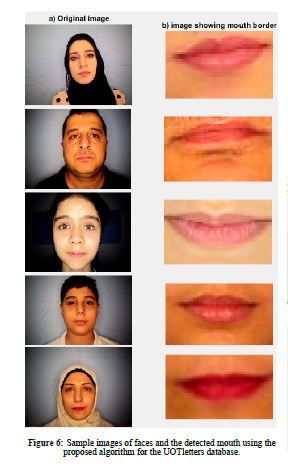
Mouth detection is an important issue in visual speech recognition. The de facto algorithm used to achieve this is the Viola-Jones algorithm. Nevertheless, time enhancement for the auto-detection of this algorithm is required. Therefore, the goal of this research is to propose a modified approach based on the Viola-Jones algorithm to enhance the detection time. The main contribution of the proposed algorithm is limiting the auto-valuing for the threshold of the Viola-Jones algorithm and enhancing the time by configuring the maximum step for the adaptive threshold value. The UOTletters database was used in the experiments of this research with 30 speakers pronouncing English letters with overall frames of 28164. The experiment results have shown that the average detection time for the proposed method was 0.585 sec, compared with the baseline method's 2.097 sec. As a result, the proposed approach enhanced the mouth detection time with respect to the baseline algorithm (358.46%). Consequently, the proposed algorithm is a good solution for real-time visual speech recognition regarding the detection time enhancement.
Full text article
References
Ali, Wisam H, R. Saeed, T., & H. Al-Muifraje, M. (2020). FPGA Implementation of Visual Speech Recognition System based on NVGRAM-WNN. 2020 International Conference on Computer Science and Software Engineering (CSASE), 132–137. https://doi.org/10.1109/CSASE48920.2020.9142095
Ali, Wissam Hassan. (2016). Pattern Recognition System for Human Utterance (Issue June). University of Technology-Iraq.
Balasubramanian, M., Palanivel, S., & Ramalingam, V. (2009). Real time face and mouth recognition using radial basis function neural networks. Expert Systems with Applications, 36(3, Part 2), 6879–6888. https://doi.org/https://doi.org/10.1016/j.eswa.2008.08.001
Berbar, M. A., Kelash, H. M., & Kandeel, A. A. (2006). Faces and Facial Features Detection in Color Images. Geometric Modeling and Imaging--New Trends (GMAI’06), 209–214. https://doi.org/10.1109/GMAI.2006.18
Ibrahim, M. Z., & Mulvaney, D. J. (2015). Geometrical-based lip-reading using template probabilistic multi-dimension dynamic time warping. JOURNAL OF VISUAL COMMUNICATION AND IMAGE REPRESENTATION, 30, 219–233. https://doi.org/10.1016/j.jvcir.2015.04.013
Indrabayu, Hasanuddin, & Nurtanio, I. (2019). An Approach in Auto Valuing for Optimal Threshold of Viola Jones. Symposium of Emerging Nuclear Technology and Engineering Novelty. https://doi.org/10.1088/1742-6596/1198/9/092003
Joshi, A., Chavan, V., & Kaveri, P. (2021). Semantic Gap Reduction From Mouth Feature Threshold Value Using Viola Jones Algorithm. ICCRDA 2020. https://doi.org/10.1088/1757-899X/1022/1/012065
Kaur, J., & Sharma, A. (2017). Performance Analysis of Face Detection by using Viola-Jones algorithm. International Journal of Computational Intelligence Research, 13(5), 707–717.
Kherchaoui, S., & Houacine, A. (2010). Face detection based on a model of the skin color with constraints and template matching. 2010 International Conference on Machine and Web Intelligence, 469–472. https://doi.org/10.1109/ICMWI.2010.5648043
Maghraby, A. El, Abdalla, M., & El, M. Y. (2014). Detect and Analyze Face Parts Information using Viola- Jones and Geometric Approaches. International Journal of Computer Applications, 101(3), 23–28. https://doi.org/10.5120/17667-8494
MathWorks. (n.d.). vision.CascadeObjectDetector (Detect objects using the Viola-Jones algorithm). Retrieved December 27, 2022, from https://www.mathworks.com/help/vision/ref/vision.cascadeobjectdetector-system-object.html
Nguyen, D., Halupka, D., Member, S., Aarabi, P., Sheikholeslami, A., & Member, S. (2006). Real-Time Face Detection and Lip Feature Extraction Using Field-Programmable Gate Arrays. IEEE TRANSACTIONS ON SYSTEMS, MAN, AND CYBERNETICS, 36(4), 902–912. https://doi.org/10.1109/TSMCB.2005.862728
Papageorgiou, C. P., Oren, M., & Poggio, T. (1998). A general framework for object detection. Sixth International Conference on Computer Vision (IEEE Cat. No.98CH36271), 555–562. https://doi.org/10.1109/ICCV.1998.710772
Radhi, A. A., Akkar, H. A. R., & Abdullah, H. N. (2022). Skewness and access kurtosis as denoised mixed features-based K-Medoids for cooperative spectrum sensing. Physical Communication, 54, 101831. https://doi.org/https://doi.org/10.1016/j.phycom.2022.101831
Ryu, Y.-S., & Oh, S.-Y. (2001). Automatic extraction of eye and mouth fields from a face image using eigenfeatures and multilayer perceptrons. Pattern Recognition, 34(12), 2459–2466. https://doi.org/https://doi.org/10.1016/S0031-3203(00)00173-4
Safi, Mohammed E., & Abbas, E. I. (2016). Microcontroller - Controlled security door based on speech recognition. In Al-Sadiq International Conference on Multidisciplinary in IT and Communication Techniques Science and Applications, AIC-MITCSA 2016 (pp. 48–53). https://doi.org/10.1109/AIC-MITCSA.2016.7759909
Safi, Mohammed Ehsan, & Abbas, E. I. (2022). Isolated word recognition based on PNCC with different classifiers in a noisy environment. Applied Acoustics, 195, 108848. https://doi.org/https://doi.org/10.1016/j.apacoust.2022.108848
Safi, Mohammed Ehsan, & Abbas, E. I. (2023). Lip Segmentation for Visual Speech Recognition Based on the Convolution Process. 2023 International Conference on Engineering Applied and Nano Sciences (ICEANS), 102–106. https://doi.org/10.1109/ICEANS58413.2023.10630463
Setu, T. A., & Rahman, M. (2016). Human Face Detection and Segmentation of Facial Feature Region. Global Journal of Computer Science and Technology: G Interdisciplinary, 16(1).
Viola, P., & Jones, M. (2001). Rapid Object Detection using a Boosted Cascade of Simple Features. Proceedings of the 2001 IEEE Computer Society Conference on Computer Vision and Pattern Recognition. https://doi.org/https://doi.org/10.1109/CVPR.2001.990517
Zhang, C., & Zhang, Z. (2010). A Survey of Recent Advances in Face Detection. Microsoft Research, 1(MSR-TR-2010-66). https://www.microsoft.com/en-us/research/publication/a-survey-of-recent-advances-in-face-detection/
Authors
Copyright (c) 2026 Mohammed E. Safi, Eyad I. Abbas,and Alaa H. Ali

This work is licensed under a Creative Commons Attribution-NonCommercial-ShareAlike 4.0 International License.
Authors who publish with this journal agree to the following terms:
- Authors retain copyright and grant the journal right of first publication with the work simultaneously licensed under a Creative Commons Attribution License [CC BY-NC-SA 4.0] that allows others to share the work with an acknowledgment of the work's authorship and initial publication in this journal.
- Authors are able to enter into separate, additional contractual arrangements for the non-exclusive distribution of the journal's published version of the work, with an acknowledgment of its initial publication in this journal.
- Authors are permitted and encouraged to post their work online.